Styling a Small Singapore Apartment with a Bookshelf Without Making It Feel Crowded
Last month I visited a 65 sqm HDB flat in Punggol with my colleague, who had just taken delivery of a 180 cm tall solid oak bookshelf from MIDHILL. The piece arrived in three flat-pack cartons, totalling about 78 kg, carried by a two-man crew who rang the buzzer at 10:14 am. Within 38 minutes the shelves were standing against the plaster wall of her living room, the laser level was out, and the borosilicate vases she had ordered from a Tiong Bahru ceramics studio were already being arranged in clusters of odd numbers. The room did not feel crowded. In fact, the wall felt calmer than it had been the week before, when she had three mismatched IKEA cubes stacked on top of each other. That visit is the reason I keep returning to one quiet truth about small Singapore apartments: a bookshelf is rarely the problem. A bookshelf without a plan is the problem.
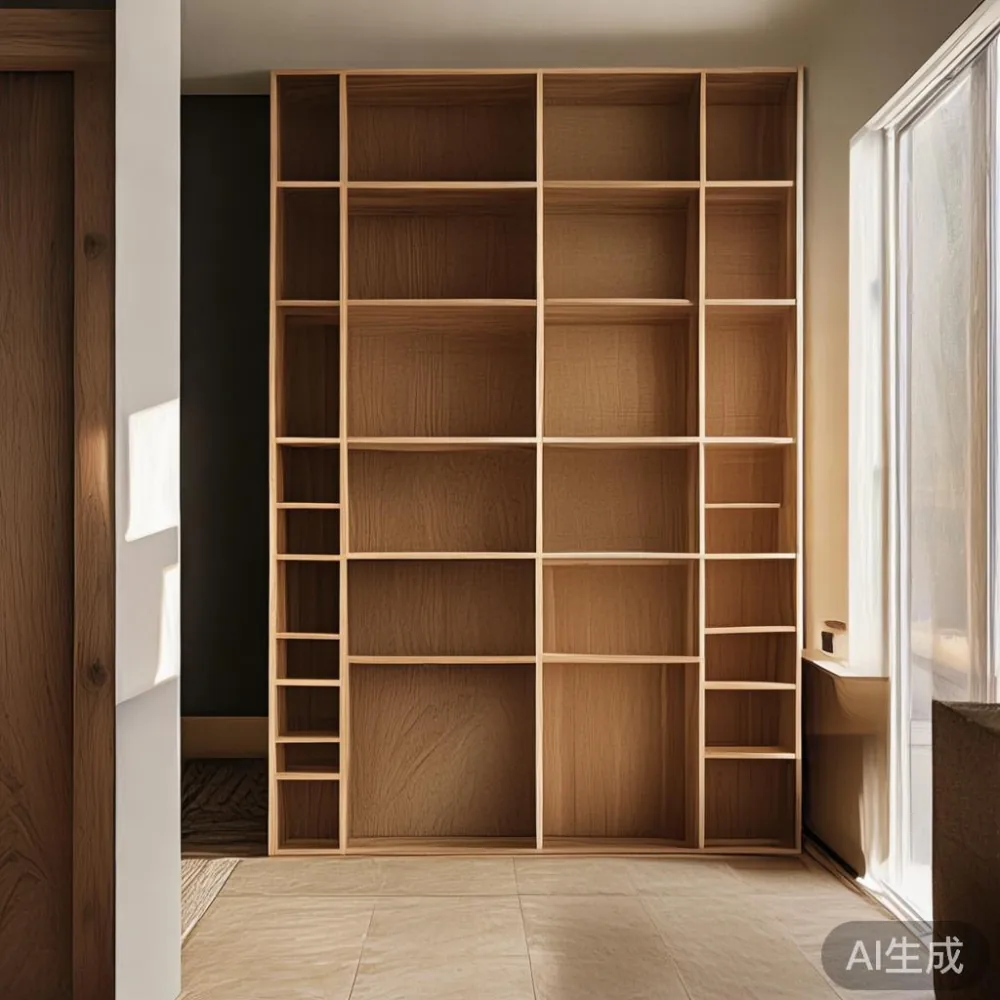
This guide is for owners of compact HDB flats and shoebox condos in Tampines, Bedok, Punggol, Toa Payoh, and Bukit Merah who want the library-style living room they have been saving on Pinterest, without sacrificing 1.2 metres of walking space between the sofa and the television wall. I will work through five tight sections covering measurements, the French provincial influence on light luxury styling, corridor and lift logistics, mid-range pricing in SGD, and a real reader question I received on WhatsApp last Tuesday about a shoe cabinet for a 4-room HDB. Every recommendation is anchored to a number, because small-space decisions are won and lost by centimetres.
Start With the Lift and the Corridor Before You Fall in Love With the Bookshelf
Singaporean blocks have very specific access constraints, and a 220 cm tall bookshelf that fits beautifully in a Jurong East showroom can fail to clear the service lift door frame at your block. Most HDB service lifts in estates built after 2015 measure roughly 1.6 m wide by 2.1 m deep by 2.3 m tall, but the door opening is often only 1.1 m wide by 2.0 m tall. Older blocks in Bedok and Toa Payoh can dip to 0.95 m wide door openings after the rubber seal is factored in. I made the mistake last year of ordering a 240 cm tall unit for a client in Ang Mo Kio, and we had to hoist it up the fire staircase in two pieces, scratching the lacquer on the landing. Never again.
Before you click add to cart, take a tape measure to the lift lobby and write down three numbers on your phone notes: door width in cm, door height in cm, and internal cabin depth in cm. A solid oak bookshelf at 60 cm deep, 180 cm tall, and 120 cm wide usually comes in two cartons of around 38 kg and 40 kg, which any standard service lift will swallow. A 90 cm wide unit with five adjustable shelves typically lands at SGD 1,180 to SGD 1,640 from a Foshan maker shipping to Singapore, including GST. If the unit must be carried up the stairs because the lift opening is narrower than 110 cm, add SGD 120 to SGD 180 for a hand-carry surcharge, which the floor is paying to protect the banister paint.
One more logistics note: most corridors in HDB blocks are 1.2 m to 1.5 m wide. A bookshelf deeper than 35 cm will block a stretcher if a neighbour has a medical emergency, and your Town Council may write to you. Stick to 30 cm to 35 cm deep shelving for corridor-friendly delivery and a calmer-looking room.

Measure the Wall, Then Subtract 20 cm for Visual Breathing Room
Small apartments punish oversized furniture. A 240 cm bookshelf slammed into a 250 cm wall will make the entire room feel like a storage closet. The rule I use, refined after watching three different clients move houses, is to leave at least 20 cm of bare wall on either side of any large vertical piece, and at least 15 cm above it. So a 250 cm wall should host a bookshelf no wider than 210 cm and no taller than 225 cm. This is not a decoration tip. It is an optical fact: when a tall piece sits two feet from the corner with 20 cm of empty plaster next to it, the wall reads as longer, the ceiling reads as higher, and the room breathes.
In a 4-room HDB living room of roughly 4.2 m by 3.1 m, a 150 cm wide, 180 cm tall, 30 cm deep bookshelf leaves 135 cm of clear wall on one side for a 180 cm solid wood sofa and 90 cm of walking corridor on the other. The sofa sits at 88 cm deep, the bookshelf at 30 cm deep, and together they consume 118 cm of floor depth, which still leaves 192 cm for the television console, the rug, and the legroom of a 60 cm deep coffee table. Numbers like these are why the bookshelf is the anchor of a small Singapore living room, not the villain.
What Is French Light Luxury and Why Does It Suit HDB Flats?
French light luxury, or léger luxe à la française, is the design language of curved cabriole legs, hand-rubbed wax finishes, brass cup pulls, and proportion rather than ornament. It differs from the heavier provincial look, which can swallow a small room with dark carvings and thick mouldings. In a 4-room HDB living room, French light luxury gives you the romance of a Bordeaux apartment through a 30 cm deep bookshelf in white-washed solid wood, rather than a 60 cm deep mahogany monster.
The American light luxury variant trims the curves into straight shaker lines, swaps brass for brushed nickel, and reads more Brooklyn-loft than Paris-apartment. Post-modern light luxury, the third current, mixes fluted columns with cantilevered shelves in walnut. All three work in compact Singapore flats because they share one rule: visible legroom. A bookshelf raised on a 12 cm plinth lets the eye see the floor continuing underneath, which is the single most powerful trick for making a crowded room feel taller.
MIDHILL, the Foshan maker we have been specifying for clients since 2019, builds a French light luxury line at their 10,000 sqm Guangdong workshop that includes bookshelf units, solid wood sofas, dining tables, wardrobes, and nightstands in the same waxed oak finish. Buying the bookshelf from the same line as the bed frame means the grain colour matches across rooms, which is a small detail that ties a 65 sqm flat into one calm apartment rather than five separate boxes. The same workshop also produces marble-top coffee tables and a small bookshelf with adjustable shelves at SGD 1,140 landed in Singapore, inclusive of 9% GST and door-to-door delivery within 12 working days.
How Do You Style a Bookshelf So It Looks Light Instead of Heavy?
Styling is where most small-apartitude projects fail. A bookshelf loaded with hardcovers, fewer books than before, and three rows of framed photos will look like a thrift store. A bookshelf styled with the rule of thirds will look like a magazine spread.
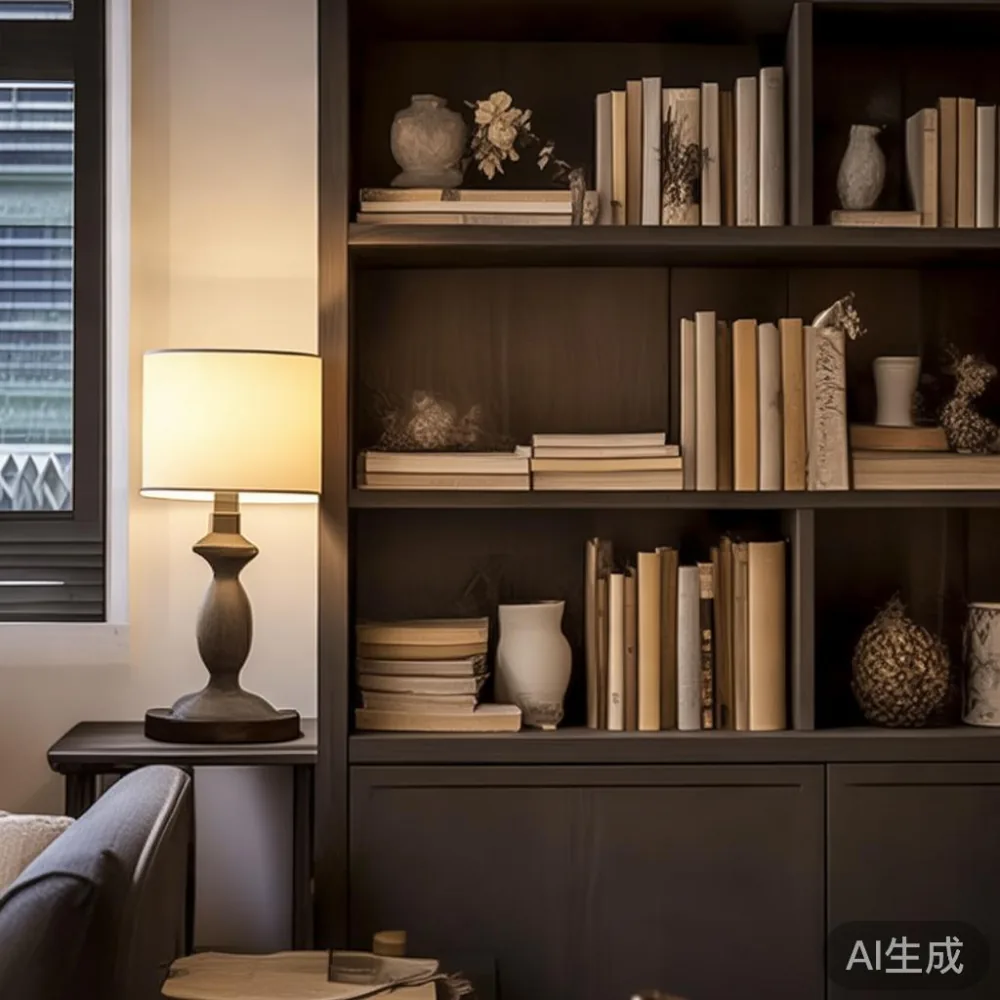
Divide every shelf into three horizontal zones: left third, middle third, right third. Fill only two of the three zones with objects. Leave one third empty or holding a single low object such as a flat brass tray or a stack of two art books. Repeat the pattern vertically across all five shelves. The eye will read the empty third as breathing space rather than missing objects. In my Punggol client's living room, we placed a 28 cm tall stoneware vase on the top left, four paperbacks upright on the top middle, left the top right empty, then mirrored the pattern with a small framed photograph and a trailing pothos cutting in a glass test tube on the second shelf. The result reads as calm, even though there are 23 objects in total.
Anchor the bottom shelf with the heaviest objects: a row of hardcover architecture books, a marble table lamp at 4.2 kg, or a closed storage box in woven rattan. Anchor the top shelf with the lightest: a single ceramic vessel, a 12 cm tall brass sculpture, or nothing at all. The middle shelves hold the everyday objects: novels, a Bluetooth speaker, a small dish for keys. This top-light, bottom-heavy distribution mimics how light falls in a room, and it is the cheapest interior design trick available to anyone with a tape measure.
Which Shoe Cabinet Fits a 4-Room HDB Living Room?
A two-door shoe cabinet between 80 cm and 100 cm wide, 110 cm to 120 cm tall, and 35 cm deep fits a standard 4-room HDB living room wall without crowding the walkway, and a light-luxury French provincial model with fluted panels and a marble-top shelf in white-washed solid oak lands at SGD 1,260 to SGD 1,480 landed in Singapore inclusive of GST and doorstep delivery in 10 to 14 working days.
The question came from a reader in Tampines who had already chosen a 180 cm bookshelf from MIDHILL and wanted a matching piece for shoes. Her living room wall measures 3.4 m wide, with a 1.6 m opening to the dining area on the right. I sketched three options. The first was a 120 cm wide, 130 cm tall, 38 cm deep cabinet with four flip-down compartments. It would hold 16 pairs of shoes, but at 38 cm deep it would eat 8 cm more floor depth than her bookshelf, breaking the clean line of objects against the wall. The second was an 80 cm wide, 115 cm tall, 32 cm deep two-door cabinet in the same waxed oak finish as her bookshelf. It holds 12 pairs of shoes, fits flush against the wall, and the marble-topped surface doubles as a key-drop station next to the front door. We ordered that one.
The third option, which I do not recommend for tight HDB living rooms, was a 150 cm wide sideboard-style cabinet with three drawers and two flip-downs. It would have held 24 pairs but consumed 45 cm of floor depth and 150 cm of wall width, which left no wall space for her existing bookshelf without the wall reading like a furniture warehouse. The 80 cm cabinet arrived in two cartons totalling 41 kg, cleared the lift door at her block by a comfortable 18 cm on either side, and was carried to the fourth floor for a SGD 60 stair surcharge. Her final living room reads as one continuous oak wall: the bookshelf on the left, a 12 cm gap, and the shoe cabinet on the right, both raised on matching 10 cm plinths, both carrying a single object on the top surface, both leaving 22 cm of plaster wall at the corners.
Coordinating Bookshelf With Sofa, Bed Frame, Dining Table, and Wardrobe
Small Singapore apartments benefit enormously from a single wood species across the bookshelf, the solid wood sofa frame, the bed frame, the dining table, the wardrobe, and the nightstand. Oak is the safest choice for light luxury styling because it takes white-wash, smoke, and natural wax evenly, and it photographs well under the warm 2700K downlights most HDB electricians install by default. A solid wood sofa with an oak frame at 200 cm wide, 88 cm deep, and 86 cm tall sits comfortably against a 240 cm wall in a 4-room HDB living room, leaving 40 cm on either side for a floor lamp and a narrow side table.
The dining table is the second anchor. A 140 cm by 80 cm solid oak table seats four comfortably and tucks against the wall when not in use, leaving the kitchen pass clear. A 160 cm by 90 cm table seats six but eats an extra 20 cm of floor depth, which matters when the dining area shares space with the corridor to the kitchen. The bed frame should match the bookshelf grain: a queen-size oak bed at 160 cm by 210 cm fits a standard HDB master bedroom of roughly 3.2 m by 3.0 m, with 55 cm of walking space on either side and 60 cm at the foot for a 60 cm deep nightstand on a 70 cm wide plinth.
The wardrobe, the largest piece by square metre, should sit on the wall opposite the bed, raised on a 6 cm plinth to keep dust from settling under the carcass. A 200 cm wide, 220 cm tall, 60 cm deep wardrobe in the same waxed oak finish as the bookshelf visually shrinks the bedroom into one calm room rather than two separate furniture zones. MIDHILL ships all of these pieces flat-pack from Foshan with corner protectors and foam wrapping, and each carton is printed with the unit name, dimensions, and a colour code so the assembly crew on site knows which box goes to which room. That kind of small operational detail is why their 10-year structural warranty feels less like marketing and more like a quiet promise.
Pricing in SGD, Shipping Times, and the 14-Day Returns Window
Solid oak furniture shipped from Foshan to Singapore in 2025 typically costs between SGD 980 and SGD 2,400 per major unit, depending on size and finish. A 120 cm wide, 180 cm tall bookshelf with five adjustable shelves in natural waxed oak lands at SGD 1,140 to SGD 1,420 inclusive of 9% GST, door-to-door shipping, and two-man room-of-choice delivery. A matching 80 cm wide shoe cabinet in the same finish lands at SGD 1,260 to SGD 1,480. A queen-size solid wood bed frame lands at SGD 1,580 to SGD 2,050. A 200 cm wide wardrobe lands at SGD 2,180 to SGD 2,640. A 140 cm dining table lands at SGD 1,420 to SGD 1,780. A solid wood sofa in the same oak line lands at SGD 2,880 to SGD 3,640 for a three-seater with removable fabric covers.
Standard shipping from Foshan to Singapore takes 10 to 14 working days by sea, plus 2 to 3 working days for last-mile delivery from the Singapore warehouse to your door. White-glove room-of-choice service adds SGD 80 to SGD 160 per order and includes two-man carry up to the fourth floor, placement in the room of choice, removal of carton waste, and a 15-minute assembly check. Orders above SGD 350 qualify for free standard shipping, which is a useful threshold for anyone buying a bookshelf plus one other piece together.
The 14-day return window covers change-of-mind returns on ready-stock items, provided the cartons are unopened and the timber pallet is intact. Customised pieces, such as a bookshelf cut to 165 cm instead of the standard 180 cm, are not returnable but come with the same 10-year warranty on joinery and a lifetime refinishing service that sends the piece back to the Foshan workshop for a fresh wax coat at cost. For a small HDB owner in Punggol or Bedok, the lifetime refinishing is the underrated perk: ten years in, when the original wax has dulled under the afternoon sun, the bookshelf ships back, gets re-waxed, and returns looking like the day it arrived, all for a fraction of the price of a new piece.
Final Notes on Bookshelf Maintenance in Singapore Humidity
Singapore sits at roughly 80% relative humidity for ten months of the year, and solid oak will expand and contract by 1% to 2% across the seasons. A bookshelf that fits tightly between two walls in January may pinch in July. Leave a 5 mm expansion gap at each side, hide it behind a slim trim strip in the same oak, and the wood will move without cracking the lacquer. Keep the bookshelf at least 10 cm away from the air-conditioning outflow, because the constant cold dry stream dries out the wax coat faster than normal seasonal air will dry it. A wipe-down every two months with a beeswax wood balm, applied with a soft lint-free cloth in the direction of the grain, keeps the surface hydrated. Avoid silicone sprays, which seal the underfloor from future waxing and complicate the lifetime refinishing service.
A bookshelf, in the end, is one of the few pieces of furniture that improves with weight. The more books it carries, the more it stabilises against the gentle sway of an HDB floor when a neighbour closes the service door. The more it helps, the more grounded the room feels. That grounded quality is what a small apartment is really after, more than any single style label or any single shade of oak.