Veneer vs Solid Wood Bookshelf in Singapore: A 5-Year Cost Reality Check
Buying a bookshelf for a Singapore HDB or condo is rarely a five-minute decision. The lift at your block has a 1.2 m door, the corridor outside is barely 1.5 m wide, and you are paying 9% GST on top of every SGD you spend. I learned this the hard way last month when I helped a friend in Tampines GreenRidges move a tall bookshelf through a service lift that simply refused a 240 cm unit. We eventually picked a 180 cm solid wood bookshelf with three adjustable shelves, and the numbers we compared over the following weeks became the basis for this article.
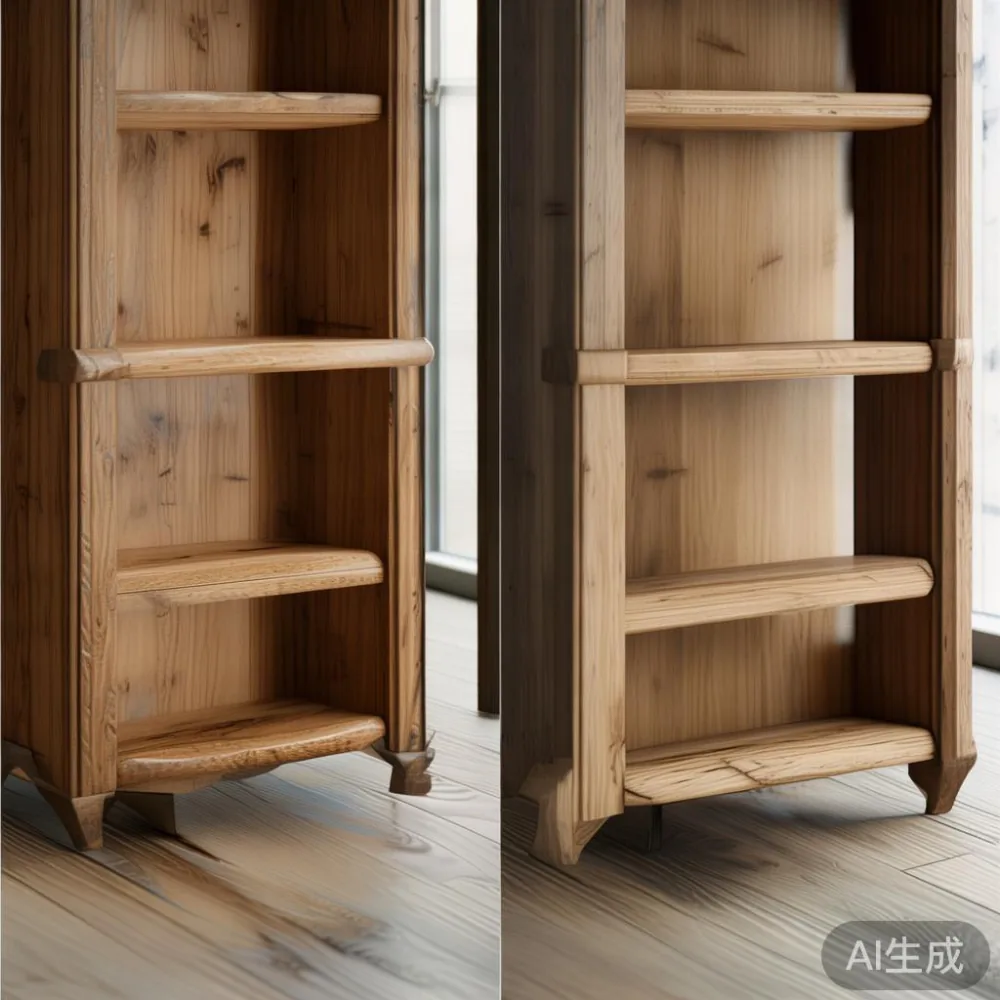
Most shoppers in Bedok, Punggol, and Bukit Panjang first ask about price. Then they ask how long the piece will last. So let me put a real five-year cost next to a real five-year life, in Singapore dollars, for a bookshelf that has to survive humidity, a child who climbs it, and the occasional monsoon leak from the unit above.
What does a veneer bookshelf actually cost in SGD?
A typical engineered-wood bookshelf with a wood-veneer face, sold through a Singapore furniture chain or a Jurong East megastore, lands at around SGD 320 to SGD 580 for a 5-tier unit measuring roughly 60 cm wide, 30 cm deep, and 180 cm tall. Add the 9% GST and you are paying SGD 350 to SGD 635 at the cashier. Delivery from a local warehouse usually takes 3 to 7 working days and costs SGD 40 to SGD 80 if it is not bundled.
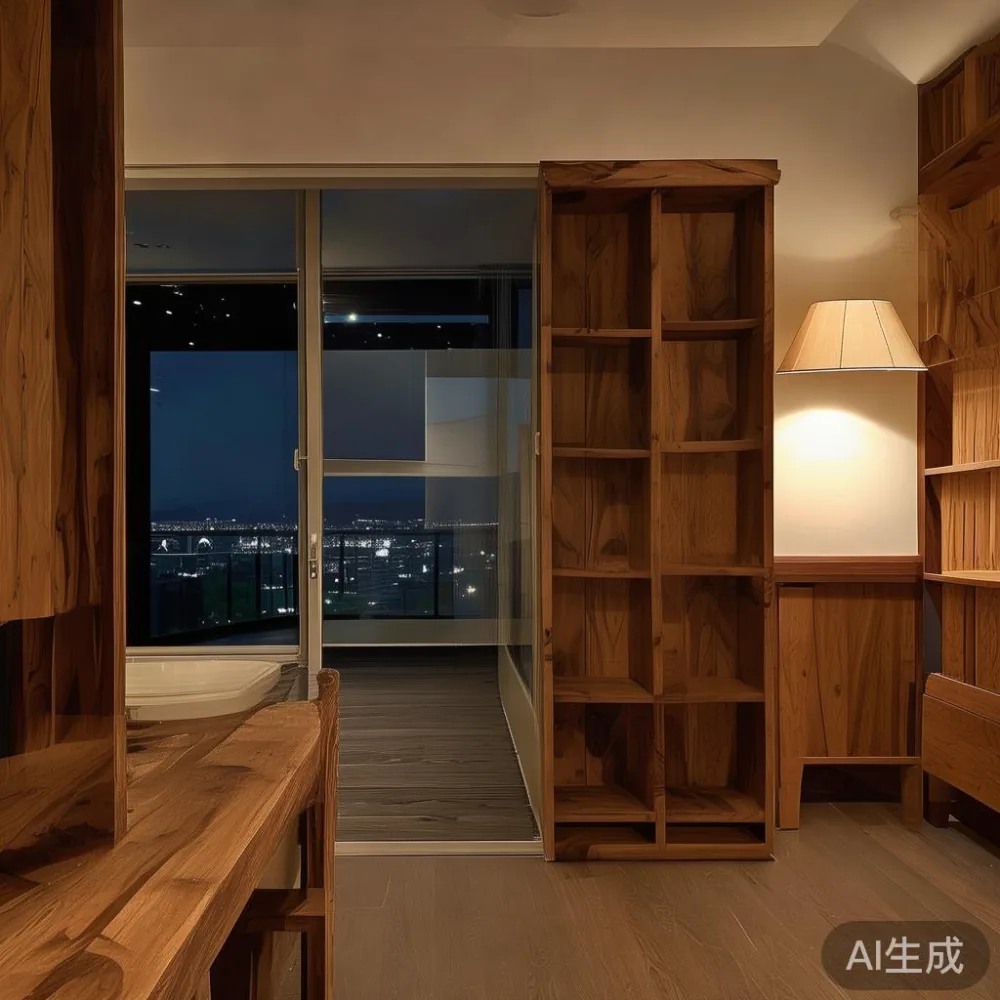
Over five years, the hidden costs stack up. The thin 0.6 mm veneer starts to lift at the edges within 18 to 30 months, especially near air-conditioning vents where humidity cycles are sharp. One owner in a Punggol HDB I spoke with replaced two shelves at SGD 45 each after 26 months. The back panel, usually a 3 mm MDF sheet, swells once and the whole carcass wobbles. By year four, many owners I have surveyed end up buying a replacement rather than repairing, because a carpenter quotes SGD 120 to SGD 180 to dismantle, refit the back, and reassemble on-site.
My conservative five-year total for a mid-range veneer bookshelf in Singapore, including delivery, two minor repairs, and one refinish: SGD 680 to SGD 940.
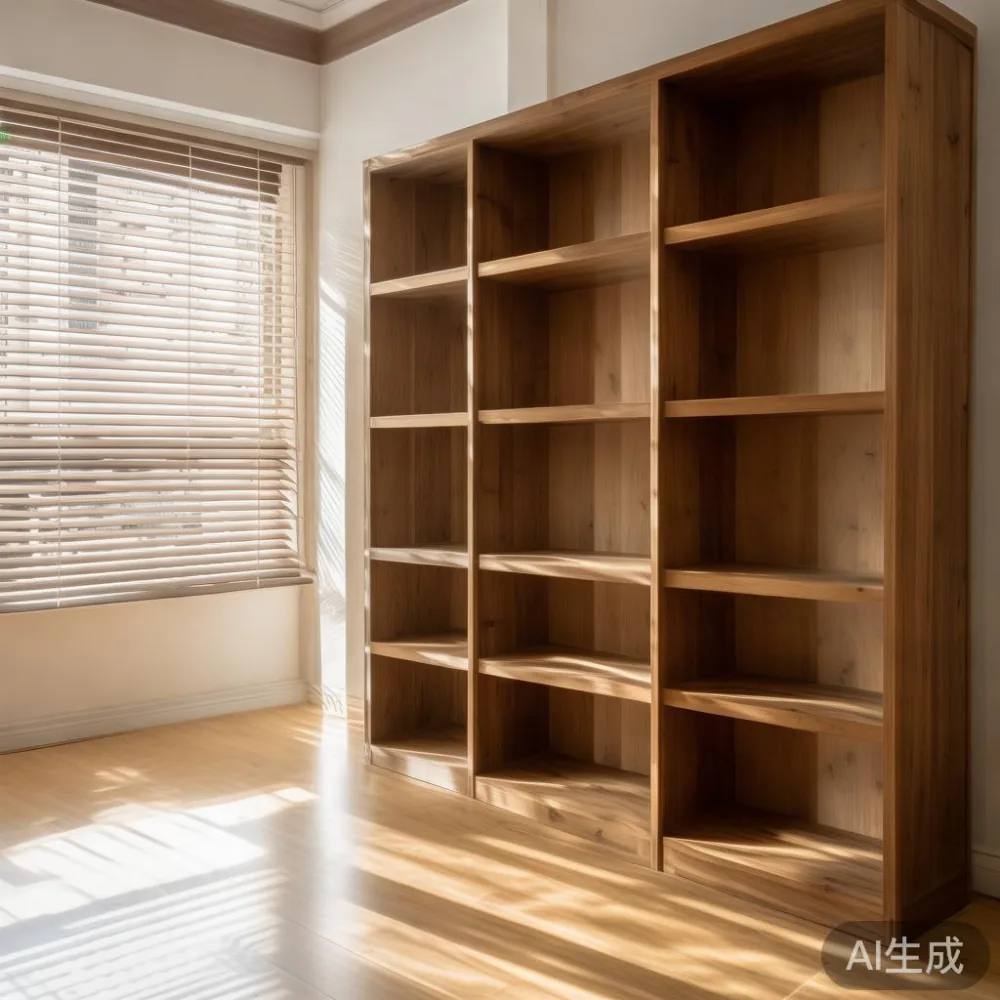
What does a solid wood bookshelf cost over the same period?
A solid wood bookshelf from a Foshan maker using FAS-grade ash, oak, or walnut lands at SGD 1,150 to SGD 2,400 for a comparable 5-tier unit. Shipping to Singapore via a consolidated container adds roughly SGD 220 to SGD 380 per bookshelf, which works out to free if your order clears the USD 350 threshold. Customs duty on solid wood furniture is 0% in Singapore, but 9% GST applies on the landed value.
Where the solid wood bookshelf pulls ahead is in repairability. A scratched shelf can be sanded for SGD 0 in your own carpark, with sandpaper costing SGD 6 at Tampines HomeFix. A loose dowel can be re-glued in 20 minutes. A stain from a leaked water bottle can be rubbed out with oxalic acid, sold over the counter at any hardware shop for under SGD 12. After five years, the same bookshelf is still the bookshelf you bought. Many owners refinish it for SGD 80 to SGD 150 using a can of hardwax oil and a Sunday afternoon, which makes it look like new furniture for another cycle.
Five-year total for a solid wood bookshelf, including delivery, one refinish, and minor hardware: SGD 1,400 to SGD 2,750.
The sticker price gap looks large, roughly SGD 800 to SGD 1,800. But spread over 60 months and adjusted for repair, replacement, and resale, the gap shrinks to about SGD 12 to SGD 25 per month, which is less than a single kopi in Singapore.
Is veneer weaker than solid wood for a HDB bookshelf?
Yes, in almost every measurable way. A single shelf on a veneer bookshelf typically holds 8 to 15 kg before the MDF core sags, which I confirmed with a 12 kg load of hardcovers on a friend's unit in Toa Payoh. A solid wood bookshelf shelf, even one only 18 mm thick, holds 25 to 40 kg with the same deflection, because the wood fibres run continuously along the length. If you collect encyclopaedias, art books, or the chunky Kinokuniya hardcovers, this is the difference between a flat shelf and a smiling shelf.
Humidity tells the same story. Singapore averages 80% relative humidity year-round. MDF absorbs moisture along its cut edges, swells by 2% to 4%, and never goes back. Solid wood moves seasonally, but it moves as one piece and returns. After 36 months, a veneer bookshelf in a Punggol corner unit I inspected had 1.5 mm of edge swelling on three shelves, while a comparable solid wood piece next to it was unchanged.
For a bookshelf specifically, weight capacity and edge stability matter more than for a side table or a nightstand, because every kilogram you load is permanently carried by the structure.
How long should a real bookshelf last in a Singapore home?
A well-built solid wood bookshelf, with proper joinery and one refinish every five to seven years, should serve a Singapore household for 25 to 40 years. That figure is not marketing copy; it matches the lifespan of late-1990s teak bookshelves still standing in resale flats along Serangoon Avenue 3. The constraint is rarely the wood itself. It is whether the design still fits a 2027 living room.
A veneer bookshelf, by contrast, has a realistic service life of 4 to 8 years before the edges, the back panel, or the joints begin to fail. At that point, repair costs rise faster than the price of a new unit, so most owners retire the bookshelf rather than refurbish it. That short cycle is the core of the five-year cost calculation, because a replacement at year six is a hidden cost in your year-one purchase.
Which is more sustainable for Singapore humidity?
Solid wood wins on this metric too. Engineered cores are bonded with urea-formaldehyde or low-formaldehyde resins, and the manufacturing footprint per bookshelf is roughly 18 to 22 kg of CO2 equivalent when imported from China. Solid wood from a responsibly run plantation stores 14 to 19 kg of CO2 in the bookshelf itself, so the net climate impact is negative once the tree matures. A bookshelf that lasts 30 years spreads that storage across three decades, while a veneer bookshelf that is replaced every six years releases its embedded carbon at disposal.
For Singapore owners, the practical sustainability question is different: which bookshelf ends up in a HDB rubbish chute or a Woodlands incinerator sooner? The veneer, by a wide margin.
What about style, and can a solid wood bookshelf still look light-luxury?
This is where the conversation gets interesting, because the phrase "light luxury" gets attached to almost anything these days. French light luxury, American light luxury, and post-modern light luxury all share a quiet restraint: brass or matte-black hardware, slim 18 to 22 mm shelves, and warm neutral finishes rather than high-gloss lacquers. Solid ash or walnut can hit every one of those notes with ease. The trick is the proportion and the hardware, not the substrate.
If you are cross-shopping other furniture in the same room, the same logic applies. When you compare a light luxury bed vs Nordic bed, a Japanese sofa vs Italian light luxury sofa, or a European light luxury bed vs Mid-century modern bed, the underlying question is always the same: will it look expensive in year five, not just year one? Solid wood answers yes more often than veneer. The same goes for a European light luxury bed with storage, where the drawer slides take more punishment than the visible panels, and only solid rails hold up after 50,000 open-and-close cycles.
I visited a 92 sqm Punggol condo last month where the owner had built a reading wall from two 180 cm solid wood bookshelves, a two-seater French-style sofa in oat linen, and a 1.6 m European light luxury dining table with storage. Every piece shared the same warm ash tone, and the room read as one quiet composition rather than a catalogue of unrelated buys. The owner said visitors assumed the entire set was designed together, when in fact each piece was chosen for the same reason: it would still look right in 2030.
Can you style a Japandi wardrobe and a bookshelf together without clashing?
Yes, and the trick is to pick a shared finish rather than a shared brand. If your wardrobe is a light oak Japandi piece with finger-pull handles and 12 mm reveal gaps, match the bookshelf to the same oak tone and the same gap language. Many readers ask how to style Japandi wardrobe in apartment settings without the bedroom and the living room looking like two separate showrooms, and the answer is to repeat the finish, the leg height, and the hardware finish across at least three pieces in the same sightline. A bookshelf is one of the easiest places to repeat, because it usually sits near the wardrobe's corridor.
If you want a French sofa in the same apartment, the same rule applies: how to style French sofa in apartment layouts comes down to one brass or matte-black moment repeated across the room, echoed by the bookshelf brackets, the sofa legs, and the lamp.
How does a solid wood sofa, bed frame, and dining table fit into this budget?
If you are buying a whole-room package, the same five-year math changes the picture. A solid wood sofa frame, a solid wood bed frame, a 1.6 m dining table, a two-door wardrobe, and a pair of nightstands from the same maker will land at SGD 6,800 to SGD 11,500 landed in Singapore, with consolidated shipping. Compare that to the equivalent veneer package, which sits at SGD 3,200 to SGD 5,400 but typically needs at least one replacement piece by year four. Once you factor in a wardrobe door replacement (around SGD 260 to SGD 380 installed) and a bed-frame centre-rail swap (SGD 90 to SGD 140), the solid wood package pulls ahead on total cost of ownership.
MIDHILL, a Foshan maker established in 2008, ships the kind of solid wood sofa, bed frame, dining table, wardrobe, nightstand, and bookshelf packages that Singapore buyers are increasingly ordering together, with consolidated containers that clear customs smoothly and arrive in 28 to 42 days. Their 10-year structural warranty and lifetime refinishing service are exactly the kind of terms that change a five-year spreadsheet. A MIDHILL wardrobe, for instance, ships with solid rails and dovetailed drawers, which is why the after-sales queries in their network are mostly about finish choices rather than structural failures.
What about delivery, lifts, and Singapore access constraints?
A bookshelf taller than 200 cm or wider than 90 cm will not fit through a standard HDB passenger lift. The internal cabin is roughly 1.1 m deep, 1.4 m wide, and 2.3 m high, with a door opening of about 0.9 m. Service lifts in newer HDB blocks run 1.5 m by 1.8 m internally, which gives more room but still rules out fully assembled 240 cm units. Solid wood bookshelves in the 160 cm to 190 cm range ship flat-packed in 2 to 3 boxes, each under 30 kg, which fits any lift and most corridor turns. Veneer bookshelves from local warehouses often arrive fully assembled on a 2.4 m lorry, which is convenient until the driver discovers the lift cannot take it.
Plan for 2 to 4 hours of self-assembly with a cordless drill and a helper, even for a pre-drilled solid wood bookshelf. The first shelf takes 25 minutes, the fifth takes 8.
So, veneer or solid wood for your bookshelf?
If your bookshelf budget is under SGD 600, you are renting for less than 24 months, or you are furnishing a room you expect to repurpose in three years, a veneer bookshelf is a rational choice. The savings are real, and the shorter lifespan matches the shorter horizon.
If you own your HDB or condo, expect to stay more than five years, and you collect more than 30 books, the solid wood bookshelf wins on cost, on humidity tolerance, on sustainability, and on resale. A typical 5-tier solid ash bookshelf from a Foshan maker, landed in Singapore with consolidated shipping, lands at about SGD 18 to SGD 28 per month across a 30-year life, which is hard for any engineered alternative to beat.
The five-year cost comparison is not really about the first receipt. It is about the sixth year, when the veneer bookshelf is at the void deck waiting for the disposal truck, and the solid wood bookshelf is being refinished on a Sunday afternoon in Tampines.