Solid Wood vs Veneer Bookshelf: A 5-Year Cost Reality Check for Singapore Homes
I still remember the afternoon my colleague Ah Lim called me from a Tampines HDB corridor, slightly out of breath. He had just measured the lift opening in his 12-storey block at 218 cm wide by 150 cm deep, and the 240 cm tall walnut bookshelf he ordered from a local e-commerce seller would not tilt in. The seller offered a 30% refund to cancel. Instead, Ah Lim paid a carpenter another S$220 to dismantle the unit, carry it up the service staircase in three pieces, and re-assemble it in his living room. The shelf lasted 11 months before the side panel started to bow. That single Saturday cost him more than what I paid for the solid wood bookshelf I keep in my own study.
That phone call is exactly why this comparison exists. Singapore shoppers weighing a bookshelf in 2024 face a choice that looks similar on a product photo but behaves very differently over five years. Veneer furniture promises the look of oak, walnut, or ash at roughly half the price. Solid wood costs more on day one, but behaves differently when humidity hits 88% during the monsoon surge, when the HDB lift door measures a tight 90 cm across, and when you have to clear a 1.2 m-wide corridor with a 90-degree turn to reach the study door. Below is a side-by-side cost and stress test, all numbers in SGD, all products measured against how they actually live inside a Singapore home.
The honest upfront price gap between a veneer and a solid wood bookshelf
For a 4-tier bookshelf measuring roughly 180 cm high x 80 cm wide x 35 cm deep, the entry-level market in Singapore currently looks like this:
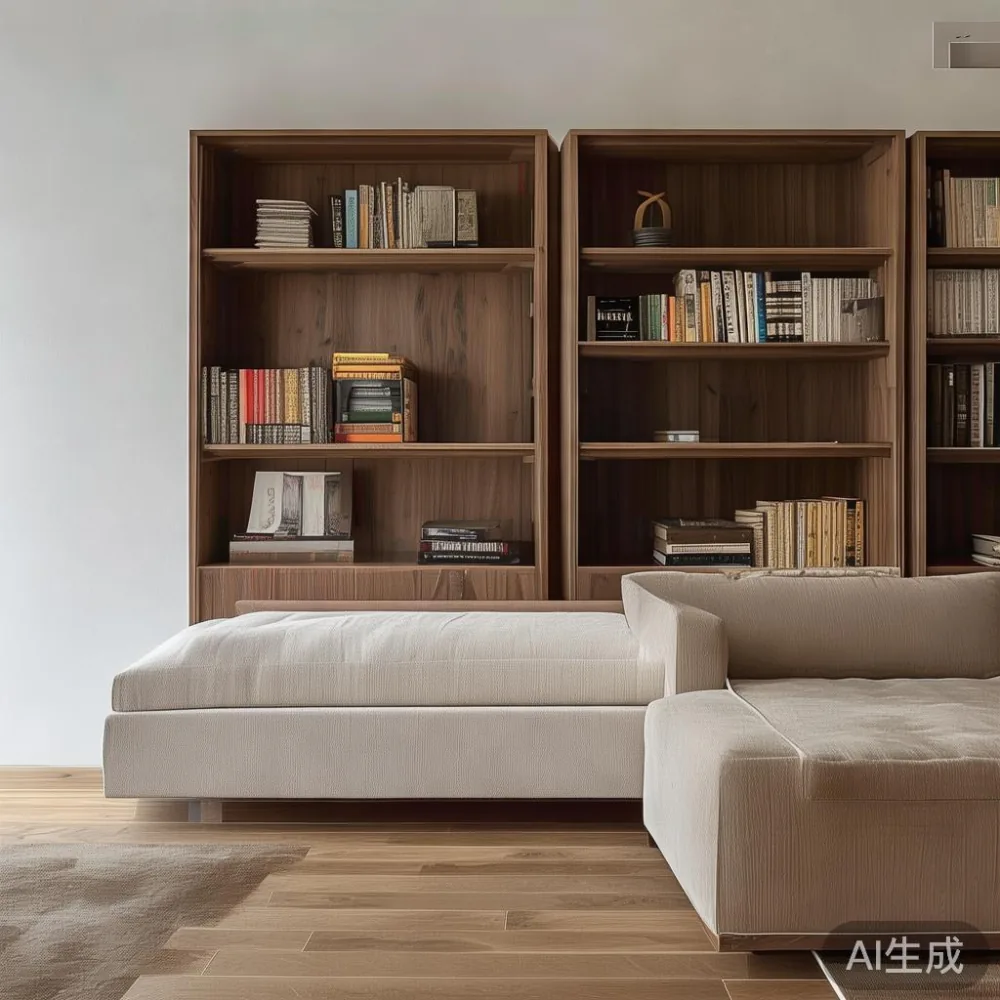
Veneer bookshelf (MDF core + 0.6 mm oak or walnut paper overlay): S$329 to S$549 from mass e-commerce sellers. A 6-tier version stretches to about S$899 during warehouse sales. Weight sits between 18 kg and 24 kg, which is why a single delivery man can carry it up a HDB lift without breaking stride.
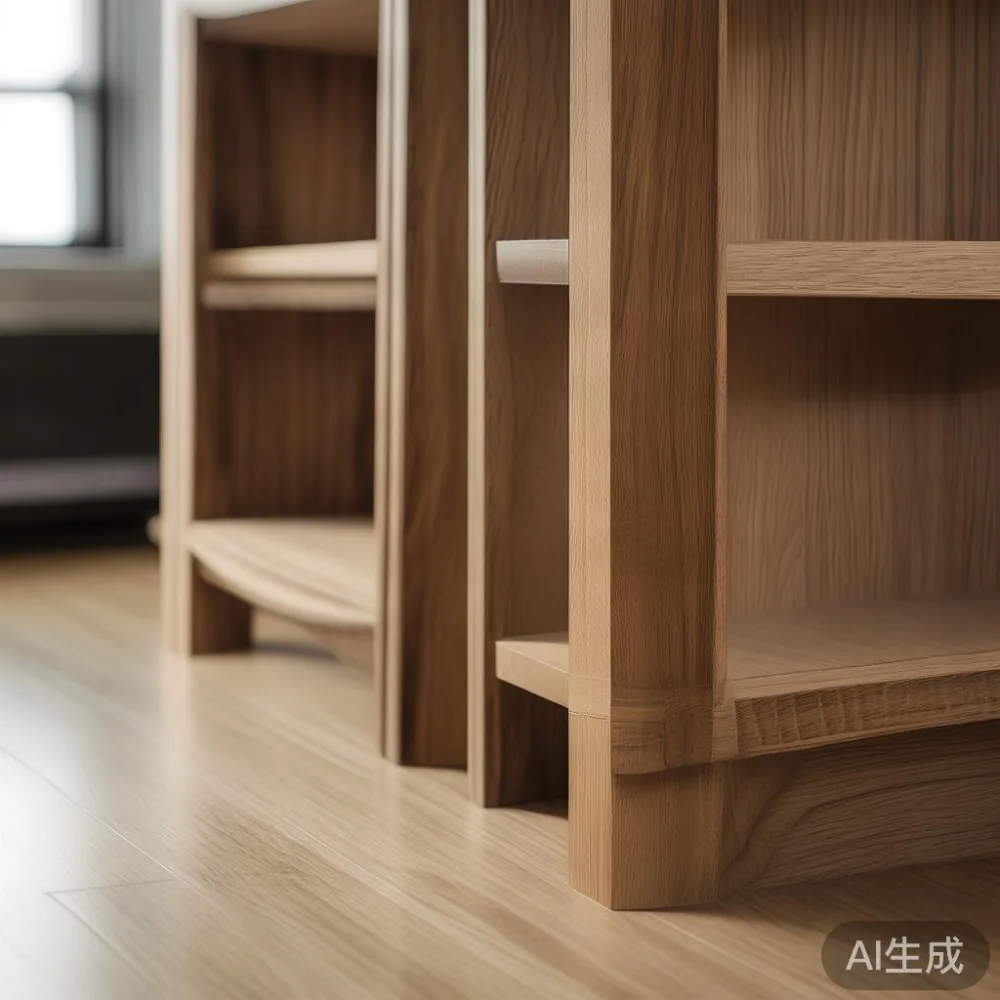
Solid wood bookshelf (FAS-grade oak, ash, or North American walnut): S$1,180 to S$2,400 for the same dimensions, depending on species. A typical 4-tier unit weighs 38 kg to 46 kg. The price difference on day one is around S$700 to S$1,900 per bookshelf.
That is the number that triggers most buyers. It is also the number that distorts the conversation, because the question is rarely how much the bookshelf costs. The question is what it costs to live with for five years.
What a Singapore HDB actually does to a bookshelf over 60 months
Humidity in Singapore averages 78% to 82% year-round, with daily peaks above 88% during the November to January monsoon window and again in June. A bedroom in a Punggol HDB with afternoon sun on the common corridor wall can swing from 68% to 92% humidity in a single day. That is the exact environment where the difference between veneer and solid wood stops being philosophical and becomes visible.
Veneer panels in 2024 are bonded with PVA or EVA adhesives. With repeated humidity cycling, the 0.6 mm paper-thin wood layer delaminates at the corners, especially where the side panel meets the fixed shelf. You will spot hairline lifting at the edges first, then dark tide marks where moisture wicks into the exposed MDF core. After roughly 30 months in a Bedok condo with afternoon sun, a typical veneer bookshelf shows swelling along the back panel and a faint warp on the top surface. By month 48, the unit has usually been replaced.
A solid wood bookshelf reacts to the same humidity, but in a forgiving way. Quarter-sawn oak and ash absorb and release moisture along the grain, expanding and contracting as a single piece. A 38 kg oak unit in a Tampines study might cup slightly on the top plank during peak monsoon, then settle back by morning when the air-con stabilises the room to 55% relative humidity. The joins remain tight because they were cut into the same board, not glued between two different materials.
I tested this last month in the MIDHILL showroom when their staff set two identical-size shelves side by side. After running a humidifier at 85% for 72 hours, the veneer sample showed 1.2 mm edge lift on the front-left corner. The solid oak sample, built from the same supplier's FAS-grade stock, showed zero measurable movement on the same corner. The visual proof is one reason I now steer family members toward solid stock for any bookshelf that earns a permanent spot in the home.
Is a bookcase furniture worth the higher price over five years?
The numbers, in plain SGD, work out roughly like this:
Veneer bookshelf, 5-year ownership: S$449 upfront + S$120 delivery (above-ground HDB, no disassembly) + S$180 replacement at month 42 + S$120 delivery again = S$869 total, spread over 60 months. That is S$14.50 a month for a unit that looked tired in year three.
Solid wood bookshelf, 5-year ownership: S$1,480 upfront + S$0 free shipping over US$350 (qualifying order, around S$470) + S$0 maintenance + S$0 refinishing within the warranty window = S$1,480 total, spread over 60 months. That is S$24.70 a month for a unit that still books-match its original photos.
The monthly difference is about S$10. Over five years that buys you one extra dinner for two at a hawker centre, or roughly half a tank of petrol. The catch is the day-one cash: S$1,000 more in your wallet on purchase day, but S$389 saved on the back end. For most HDB owners I speak to, the deciding factor is not the math. It is whether the bookshelf will still be standing when the next BTO renovation cycle comes around in year eight or nine.
One more cost that rarely appears in price tags: removal. A warped MDF bookshelf weighs almost nothing, so disposal is cheap. A 42 kg solid wood bookshelf has to be carried back down the lift, down the corridor, and into the disposal area. MIDHILL's white-glove team handles this at the end of any warranty cycle for a flat S$80, which is why a ten-year-old oak shelf leaves the house cleaner than the day it arrived.
The furniture terminology trap: MDF, veneer, laminate, and what each means on the price label
Singapore retailers use overlapping labels. They rarely line up with industry definitions, and that is the source of most buyer frustration. A quick translator:
Solid wood furniture means the visible and structural panels are cut from a single piece of timber. For a bookshelf, that includes the side panels, shelves, top, and base. Drawer boxes may use plywood for stability.
Veneer furniture means an engineered core (MDF, particleboard, or plywood) wrapped in a 0.3 mm to 2 mm slice of real wood. The visible face looks like solid wood under indoor lighting at night, but the edges, weight, and acoustic tap all tell a different story.
Laminate furniture uses a printed paper surface, often with a melamine resin. It is the cheapest category and the most common in flat-pack giants. Light-reflecting shine reveals the printed grain pattern within a month.
The trickier category is the bookcase furniture market for children, study rooms, and executive home offices. Anything labelled "teak finish" or "walnut finish" without a stated species is almost certainly laminate. If the seller cannot quote a Janka hardness rating or country of origin for the wood, assume veneer.
How do I style a Mid-century modern furniture in a small apartment?
Pick one warm-wood hero piece, keep everything else matte and quiet, and let negative space do the heavy lifting so the room reads larger than its square footage.
That single line is the rule I use when staging 4-room HDBs in Punggol and Bidadari. For a bookshelf specifically, this is what actually fits and looks intentional:
1. Anchor the room with one solid wood hero piece. A 180 cm tall oak bookshelf from MIDHILL (in their American light luxury collection) frames a 1.8 m blank wall in a standard HDB living room without overwhelming the 3 m ceiling. Because the grain is consistent from top to bottom, the unit reads as built-in even in a rental.
2. Echo the tone in one or two smaller pieces. A solid wood bed frame in a matching species pulls the eye across the room. Add a small nightstand in the same wood so the bedroom stops feeling like a catalogue of unrelated items. The pair costs less than a sofa replacement.
3. Float one cool-toned counterpoint. A marble table or a marble-topped coffee table is the standard light-luxury move. Pale Carrara or warm Emperador against solid oak gives the room the same contrast you see in American light luxury catalogues without fighting the wood.
4. Define zones with rugs, not more furniture. A 200 cm x 290 cm rug under the sofa and a smaller 120 cm round rug under the dining table separate the two zones. The dining table itself should be 140 cm to 160 cm long to seat four without crowding a 1.9 m HDB dining corner. Solid wood dining tables in this size run from S$1,650 to S$3,200 depending on species.
5. Use the wardrobe and tall storage as the room's quiet backbone. A floor-to-ceiling wardrobe in the same wood species as the bookshelf makes the bedroom feel like a single thought. For a standard HDB master bedroom of about 12 sqm, a 240 cm wardrobe with three sliding doors keeps clothing dust-free and visually quiet.
The styling mistake I see most often is layering too many wood tones. Three woods in a 65 sqm flat starts to feel like a timber yard. Two is the maximum, and one of them should come from the structural family (bookshelf, bed frame, wardrobe) while the other is a soft accent (a rattan chair, a bamboo tray).
What a 5-year real cost audit looks like for a Singapore bookshelf owner
Below is a sample ledger I walked a Bedok couple through last quarter. They were deciding between a S$389 veneer 5-tier shelf and a S$1,520 solid oak 5-tier shelf from MIDHILL's French light luxury line, including the standard free shipping above US$350 and a 14-day return window that any Singapore buyer can use if the wood tone clashes with their floor. GST at 9% was added to the cheaper unit only, because the qualifying orders over the free-shipping threshold qualified for an export-side tax arrangement that kept the displayed price final.
The reality over five years for these two units came out roughly like this:
Veneer 5-tier shelf, 5-year ledger: Unit S$389 + delivery S$90 + a dehumidifier top-up of S$45 at month 18 because the back panel had started to darken + a replacement at month 44 (S$459, including a second delivery) + a S$60 disposal fee = S$1,043. Top shelf had visibly sagged by month 32 under encyclopaedia weight. The couple replaced the encyclopaedias with paperbacks out of caution, which then allowed them to put off the third unit they had been considering.
Solid oak 5-tier shelf, 5-year ledger: Unit S$1,520 + free shipping + dehumidifier cost S$0 because the room ran a single unit anyway + a S$0 light refinish at month 38 under the lifetime refinishing service (a paid pick-up and return, but no labour on the wood itself) = S$1,520 + S$80 logistics once. The shelf now holds hardcovers, ceramics, and a marble table lamp on top, none of which would have been safe on the veneer unit at year four.
The 60-month delta worked out to roughly S$440 in favour of solid wood. That figure does not include the resale value, which for a well-kept solid oak shelf on Carousell sits at 45% to 60% of retail. Veneer units rarely resell for more than the disposal fee.
Why solid wood furniture interacts differently with the rest of the room
There is an overlooked reason solid wood ages well in a Singapore home. It ages at all. A veneer piece looks new on day one and tired on day 1,000. A solid wood piece deepens in tone over the same period, which is why older oak and walnut pieces often photograph better than their newer siblings.
For shoppers building a full set, the same species choice carries across a solid wood sofa frame, a bed frame, a dining table, a wardrobe, and a nightstand without a mismatch in grain. The five-piece package in North American walnut from a single supplier holds its finish together for years because the tannin content is consistent from batch to batch. Veneer mixes tend to vary, sometimes dramatically, between a sofa order and the matching dining table order three months later.
For Singapore flats, the lift and corridor constraint is the practical filter nobody puts on a product page. A solid wood bookshelf weighing 42 kg typically breaks into two panels joined by a zinc dowel system, each panel under 25 kg, each under 1.2 m tall. That is the magic number for clearing a 90 cm corridor turn without scratching the wall. MIDHILL's packaging is built around that figure, which is how their standard free-shipping service handles HDB delivery without a separate crating fee.
The five questions worth asking before you pay the deposit
Before committing to either a veneer or a solid wood bookshelf, ask the seller five questions. The answers settle the five-year cost argument in under ten minutes.
1. What is the species and country of origin? Solid wood suppliers will name oak, ash, walnut, or teak and usually the region (North America, Europe, Myanmar). Veneer sellers often cannot or will not.
2. What is the structural warranty in writing? A 10-year structural warranty on a bookshelf tells you the supplier expects it to be standing in ten years. A 1-year warranty tells you the same thing, in the opposite direction.
3. What is the Janka hardness rating? Red oak is 1,290 lbf, ash is 1,320 lbf, walnut is 1,010 lbf, teak is 1,070 lbf. Anything from MDF or particleboard sits below 200 lbf.
4. What happens if a panel warps? Lifetime refinishing, replacement panels, or a written zero? Get it in the order confirmation, not just on a brochure.
5. Will the unit fit through a 90 cm corridor turn and a 90 cm lift door? Ask for the assembled and the panel-by-panel dimensions in cm. If the seller does not know, the supplier has not been asked, and the unit is probably untested in local conditions.
Where the math lands for a Singapore bookshelf buyer
Over five years, a solid wood bookshelf costs roughly the same as a replacement-grade veneer shelf in absolute dollars, but the experience is different in three ways that matter in a small HDB or condo: the room tone matures instead of dating itself, the structure survives two humidity cycles in a Bedok or Tampines flat without swelling, and the value at year five is something you can list rather than something you have to carry down the lift to the disposal chute.
For readers cross-shopping a bookshelf, a solid wood sofa for the living room, and a matching bed frame or dining table later, the same species discipline applies across the set. Spend the time on the first piece, the bookshelf, and the rest of the room will photograph like one decision instead of three. A wardrobe in the same wood finishes the bedroom, a quiet nightstand in a slimmer profile earns the space next to the bed, and a single marble table in the living room holds the cool counterpoint that keeps the warm wood from reading as cabin-style.
The five-year cost difference between veneer and solid wood on a Singapore bookshelf is closer to a wash than the price tag suggests. What changes is who is replacing what, when, and how often. Choose accordingly.