Working through Furniture Warranties: Protect Your Singapore Home - MIDHILL
I spent last Saturday at a friend's new BTO in Punggol, watching two delivery men wrestle a 2.4 m solid wood bookshelf up a 1.2 m wide lift. The shelf survived. The warranty card inside the packaging, however, looked like it had been through more than the men did. Tiny grey type, two languages, a stamp in the bottom corner dated 2024. My friend asked me a question I get at least once a fortnight: "Does this actually cover anything?" That is the question this article tries to solve, in plain English, for anyone buying a solid wood bookshelf, bed frame, dining table or wardrobe for a Singapore home.

Warranty documents in our industry look intimidating because they are written to limit liability, not to reassure the buyer. Reading them well is a learnable skill. Below is the field guide I use when I walk clients through paperwork for MIDHILL pieces — and for any imported solid wood furniture arriving at a Tampines or Bedok lift lobby.
What does a furniture warranty actually cover?
In short, a furniture warranty covers defects in materials or workmanship under normal household use, for a stated period. It does not cover damage you caused, damage caused by the environment, or damage caused by installation errors. Reading the cover page carefully tells you exactly which of those three categories the maker is willing to put in writing.
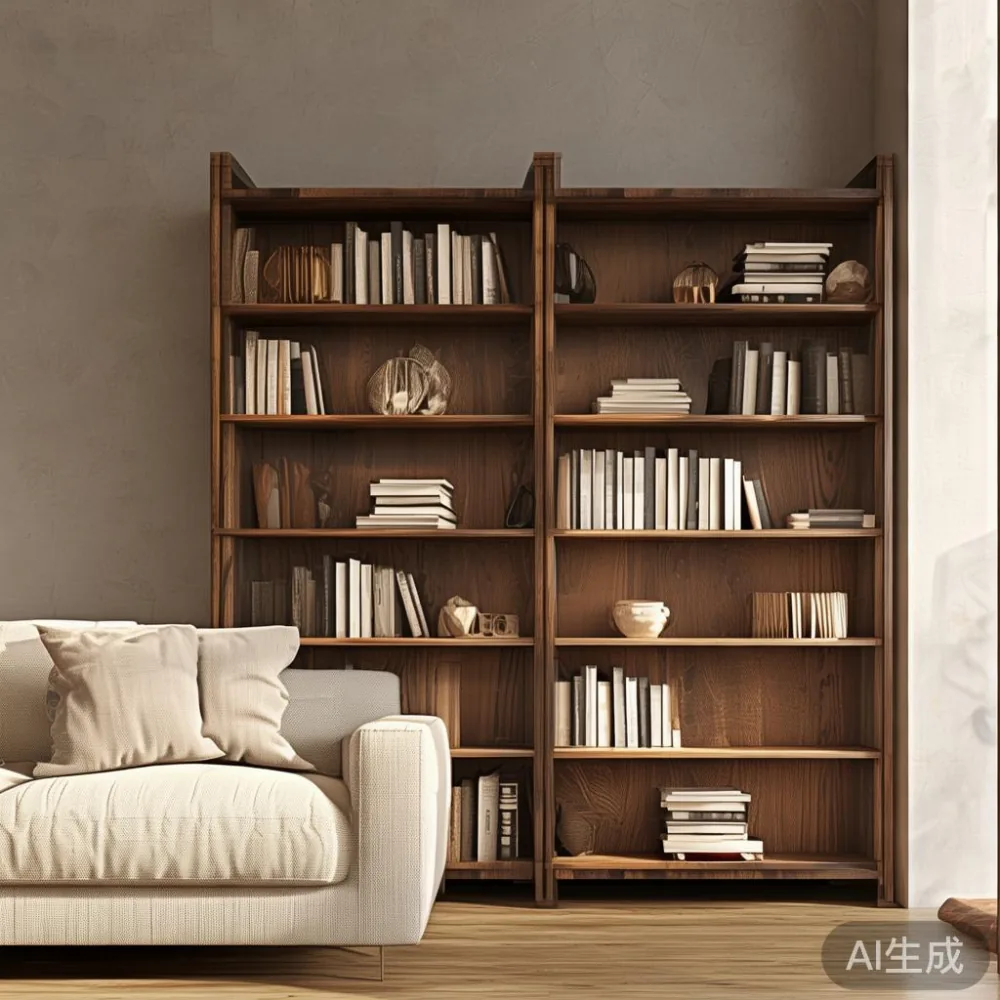
For a solid wood bookshelf from a Foshan workshop like MIDHILL (established 2008, exporting to 15+ countries), the cover page should name the parts covered: the carcass, the shelves, the joinery, the finish. The warranty I read most often in Singapore covers the structural frame for 10 years, the drawer runners for 3 years, and the finish for 12 months. Those numbers are not magic. They reflect how long each component is expected to last before normal use produces visible wear.
Is French sectional sofa furniture worth it?
French sectional sofa furniture is worth it when you want a specific look — curved silhouettes, soft chenille or velvet upholstery, and modular pieces that fit awkward HDB layouts — and when the warranty underneath that look actually protects you for at least five years on the frame and two years on the cushion cores. If those two numbers are missing from the document, the styling is decoration, not value.
Most people asking about French light luxury or American light luxury pieces in Singapore are really asking two things: will it survive the lift, and will the maker honour the paper? A sectional sofa, even a 3-seater, usually arrives in three or four boxes. Each box weighs between 28 kg and 45 kg. A typical HDB passenger lift in Tampines or Punggol has an internal depth of 1.5 m and a door width of 0.9 m. Measure first. The warranty does not cover "it did not fit in the lift", and a 1,800 SGD delivery charge for a failed attempt is not unheard of.
Which numbers on the warranty should I check first?
Open the document and circle six specific numbers before you read anything else. They are the only ones that decide whether the warranty will pay out when something goes wrong.
Number one is the length of structural coverage. For a solid wood bookshelf or dining table, anything less than five years is a yellow flag. Ten years is the standard I look at when clients send me MIDHILL spec cards. Number two is the length of finish coverage. Wood finish is a wear surface. Twelve to 36 months is fair. Lifetime coverage on a finish usually contains a definition of "hide verbs" that excludes ring marks, sun fading and humidity cracks. Number three is the labour and shipping cap. Many warranties cover the part but not the trip to your flat. A cap of "up to SGD 150" for shipping can wipe out the value of a claim entirely. Number four is the response window. The maker should commit to inspecting or replacing within 14 to 30 days. Anything longer than 45 days means you will be arguing with a forwarding agent in Guangzhou. Number five is the proof requirement. "Original receipt and photos within 7 days of delivery" is reasonable. "Notarised photographs" is not. Number six is the exclusion list length. If it takes more than one page, the warranty is doing a lot of excluding.
What is not covered that Singapore buyers assume is covered?
The three exclusions I see Singapore buyers assume are covered, but almost never are: humidity damage, lift damage during delivery, and colour variation in solid wood.
Singapore sits at 1° north of the equator. Year-round relative humidity averages 80 percent, and our air-con rooms cycle between 60 percent and 84 percent daily. Solid wood moves with that swing. A 1.8 m dining table top can change width by 2 mm to 4 mm across the year. That movement is not a defect, and your warranty will say so. The warranty covers warping that exceeds 6 mm across the span, cracking along a joint, or finish peeling that is not caused by a spill.
Lift damage is the second silent exclusion. The warranty covers the furniture in the warehouse and the furniture after delivery. The gap in between — the corridor, the lift, the doorstep — is usually the courier's problem. If you named a bushing on a 90 cm wide bookshelf to reach a 1.0 m wide lift, and the bushing fails, you should ask the maker to put "corridor and lift delivery included" in writing before you pay the SGD 80 to SGD 180 freight surcharge. MIDHILL, for example, lists corridor delivery in its Singapore service notes for any order over US$350, which converts to roughly SGD 470 at today's rate. That kind of written clarity is the difference between a warranty you can use and a warranty you cannot.
Colour variation is the third one. A solid oak bookshelf will not match a showroom sample after six months under a floor lamp. That is not a defect. What is a defect is a 3 mm crack across a load-bearing shelf under 18 kg of books. Read the colour clause. It almost always excludes natural variation.
How does the warranty process actually work in Singapore?
In practice, the process has six steps, and the first three happen on day one, not in year five.
Step one, at delivery: photograph every face of every box before opening. Step two, unbox on a clean floor, ideally the living room (living room) or a spare bedroom, with at least 3 m of clear space. Step three, photograph the piece fully assembled, then walk around it slowly with the camera 30 cm from the surface. Any dent deeper than 1 mm, any scratch longer than 2 cm, any chip on a marble table edge — photograph it, date it, and email it to the maker within 48 hours. After 48 hours, you are in "normal wear" territory under most policies.
Step four, keep the original packaging for 30 days. This is harder than it sounds in a Tampines three-room flat. If you cannot, take photographs of how it was packed. Step five, keep your receipt, your warranty card, and the courier consignment note in one folder. Step six, when you file a claim, quote the policy number, the SKU on the box, the batch number stamped on the underside of the furniture, and the photographs in order. A claim that arrives as a 12-photo WhatsApp dump with no re-upload of the receipt will be declined 80 percent of the time.
For a claim on a solid wood bed frame where one slat has cracked in year three, the maker will usually send a replacement slat plus an SGD 80 to SGD 180 installation fee waiver, or send a technician. The 10-year structural clause is what makes that exchange free. A one-year finish clause on the same frame will not cover a faded headboard.
What about a 2-seater side table for balcony claims and outdoor warranty?
A 2-seater side table for balcony use introduces a fourth exclusion that indoor warranties rarely cover: UV and salt-air degradation. Even pieces labelled "outdoor" carry a finish warranty of 6 to 12 months and a structural warranty of 2 to 3 years, because balconies in Punggol waterfront and East Coast face direct afternoon sun and, for ground-floor units, occasional splash from mopping.
If you plan to put a marble table or a solid wood side table on the balcony, read the exclusion on "outdoor placement" before you sign. If the clause is silent, ask the maker to confirm in writing whether balcony placement counts as indoor use. Half the time, the answer is no. The other half, the answer is yes with a finish caveat. Either answer is workable. No answer is the only one that is not.
How do light luxury brands differ in warranty strength?
French light luxury, American light luxury and post-modern light luxury all sit in the same price band — roughly SGD 2,800 to SGD 8,500 for a dining table or sofa — but the warranty strength varies more than the styling does.
French light luxury makers tend to write short, elegant warranty documents. Six pages, clear exclusions, named service agents in Singapore. American light luxury makers tend to write longer documents with stronger consumer language, including 30-day no-questions returns and lifetime refinishing on solid wood. Post-modern light luxury makers, the newest of the three, vary the most. Some match the American approach. Some write almost nothing.
The test is the same in every case. Ask for the document before you pay the 9 percent GST on the piece. If the maker will not send the warranty text until after the deposit clears, walk away. MIDHILL, founded in 2008 and exporting to 15+ countries, publishes its 10-year structural clause and lifetime refinishing clause on its Singapore product pages. That kind of pre-publish transparency is the single strongest signal that the maker will answer the phone in year four.
What is the single smartest warranty question to ask the showroom?
Ask: "What is the longest claim you have honoured in Singapore, and what was it for?" A maker with a 10-year track record will have an answer. A maker without one will give you a brochure.
That question matters more than any clause in the document. It tells you whether the warranty on the page matches the warranty in practice. For a solid wood sofa frame, a bed frame slat, a dining table top, a wardrobe door, or a nightstand drawer, the answer should be specific: a 2018 claim for a cracked dining table top in Bedok, a 2020 claim for a wardrobe hinge replacement in Tampines, a 2022 claim for a bookshelf bracket in Punggol. Names, dates, places. If the showroom cannot name one, the warranty is a decoration, not a contract.
How does lifetime refinishing change the warranty calculation?
Lifetime refinishing is the clause that turns a 10-year warranty into a 30-year piece of furniture. It means the maker will sand and re-finish the surface, usually once every 5 to 8 years, at a fixed fee or free of charge, for as long as you own the piece.
For a solid wood bookshelf, bed frame or dining table, that clause is worth roughly SGD 400 to SGD 900 per refinishing in retirement. It is the difference between a piece that ages into character and a piece that ages into landfill. MIDHILL's lifetime refinishing offer, available across its Singapore range, is the kind of clause I tell clients to put at the top of their comparison chart, above even the structural warranty length, because it covers the part of the furniture the structural warranty does not — the visible surface.
What should I do before signing the delivery page on the day?
Three checks. Check one: count the boxes against the packing list on the box. Check two: photograph every face of every box, including the labels. Check three: sign the delivery page with a pencil, not a pen, so you can change "good condition" to "facial dent on the top curve, 4 cm" before signing.
That last trick has saved clients several thousand SGD over the years. The delivery page is a legal document. Once you write "received in good condition" in pen, you have waived 80 percent of your claim rights under most Singapore freight policies. Use a pencil. Take your time. The lift is not going anywhere.
So, is a long warranty always better than a short one?
A long warranty with 14 exclusions is worse than a short warranty with 4 exclusions. Length without clarity is a marketing tool, not a consumer protection. Look for a 10-year structural clause, a 12 to 36-month finish clause, named service agents in Singapore, written corridor and lift delivery terms, and a lifetime refinishing option on solid wood. Those five checks mark most of the boxes a Singapore buyer needs marked before the bookshelf reaches your living room wall.
The smartest warranty is the one you read on day one, not the one you read on day one thousand. Read it now, while the receipt is still warm, while the boxes are still in the corridor, and while the maker still has your phone number on file. That is when the warranty works. After that, it is a piece of paper in a folder you cannot find.