Solid Wood vs Veneer Bookshelf: A 5-Year Cost Comparison for Singapore Homes
I still remember the Saturday morning last month when I helped my colleague carry a new bookshelf into her Bedok HDB. The lift at Block 138 measured only 1.9 m deep, and the door opening was 0.9 m wide. We had to remove the packaging, tilt the unit sideways, and even then it was a tight squeeze. She had spent S$1,490 on a "solid wood" shelf from a Jurong warehouse, only to discover later that the side panels were actually 0.6 mm okoume veneer wrapped around particleboard core. The corner chipped within six months. That visit pushed me to run the numbers honestly: over a five-year horizon in Singapore, what does a real solid wood bookshelf actually cost versus a veneered one? And how do you tell them apart before the delivery truck arrives?
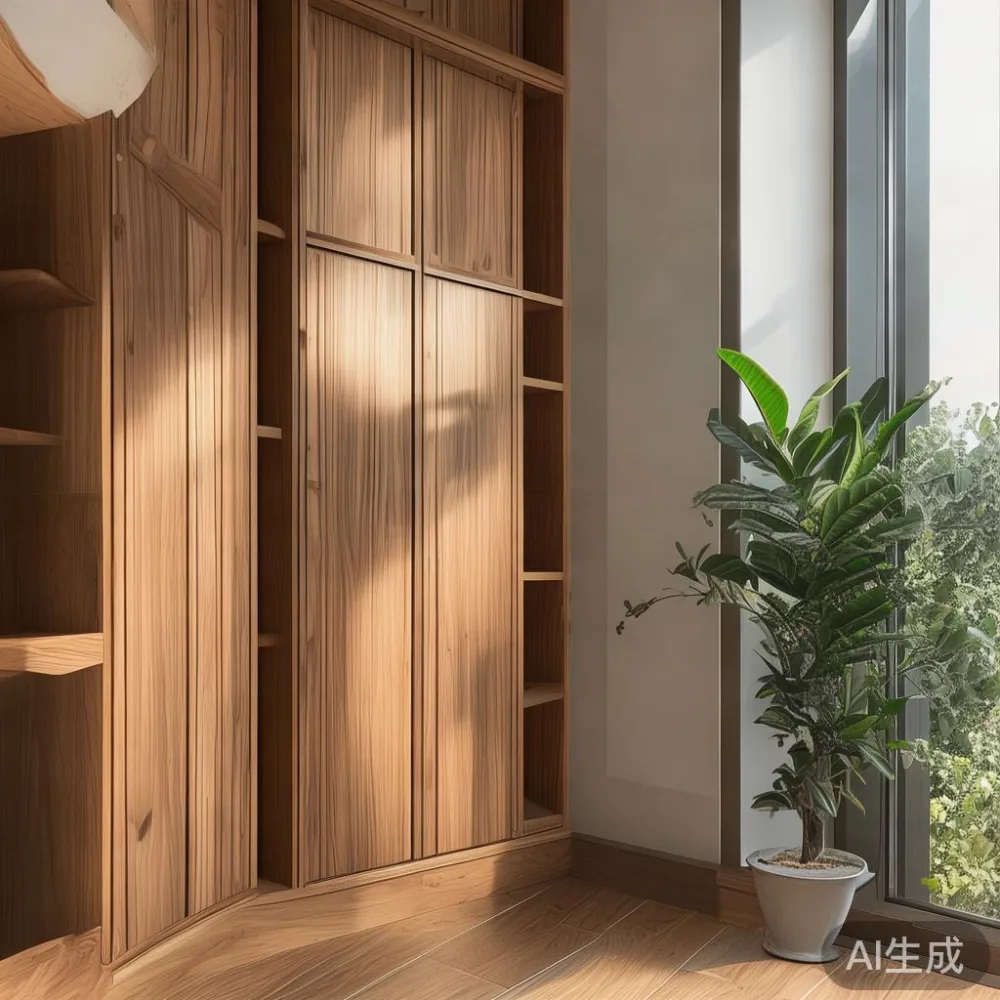
What is the real price difference between a solid wood and a veneer bookshelf in SGD?
For a standard 5-tier bookshelf around 180 cm tall, 80 cm wide, and 30 cm deep, the Singapore retail spread in 2026 looks roughly like this:
- Entry veneer (particleboard core + 0.3–0.6 mm paper or okoume face): S$220 to S$480, usually from mass-market e-commerce. - "Premium" veneer (MDF core + 0.6–1.2 mm engineered wood face, marketed as "solid timber look"): S$650 to S$1,150. - Genuine solid wood bookshelf, FAS-grade oak, ash, or walnut, kiln-dried to 8–10% moisture: S$1,400 to S$2,800 for the same footprint. - Heirloom-grade solid wood (white oak, North American walnut, or Burmese teak), with dovetail drawers and full-extension edges: S$3,200 to S$6,500.
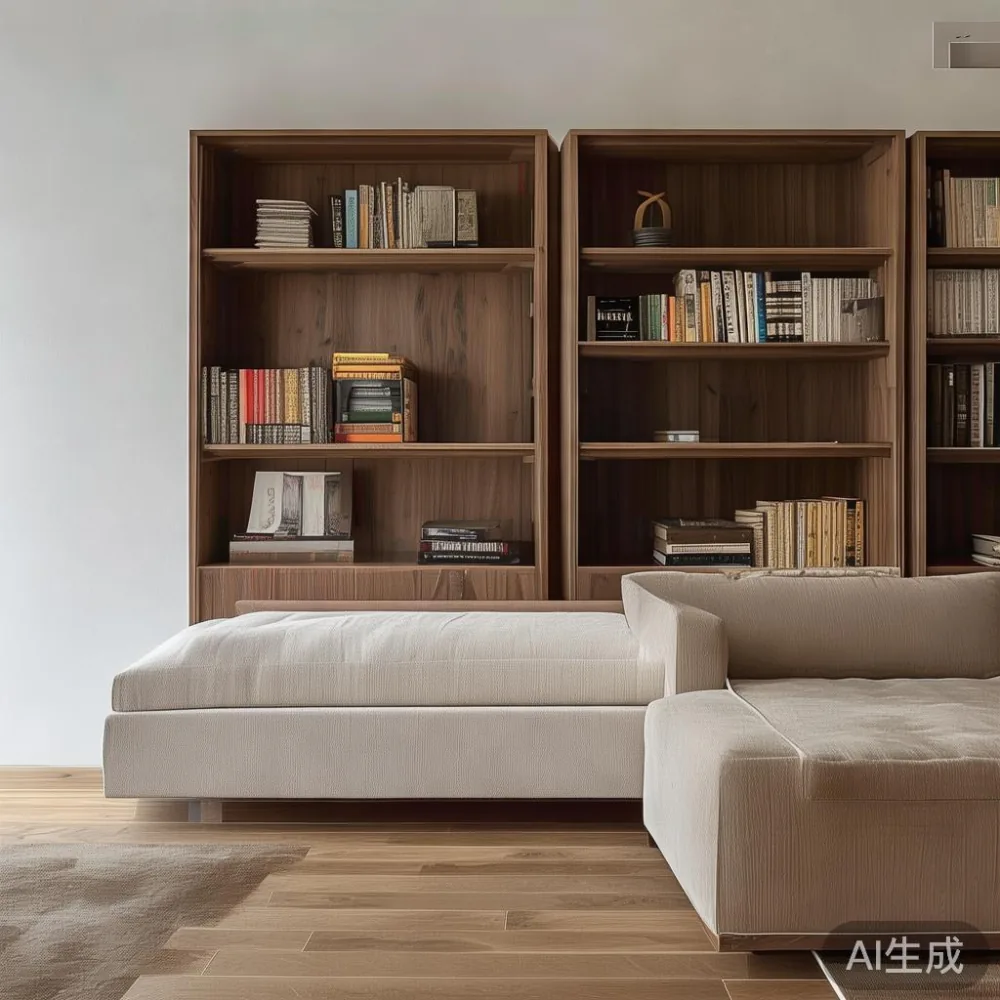
So the sticker gap between the cheapest veneered shelf and a solid oak one in Tampines or Punggol can easily hit S$1,200 before GST. With 9% GST, that is another S$108. Delivery within Singapore mainland adds S$60–S$120 depending on lift access and corridor turns. Free shipping offers kick in around the S$350 mark for many local warehouses, but most solid oak shelves never qualify.
Will a Singapore HDB's humidity destroy a veneer bookshelf in under three years?
This is the question I get from almost every Punggol BTO owner. The answer is uncomfortable: it can. Singapore sits at 32–35°C with 78–88% relative humidity for roughly nine months a year. HDB corridors and air-conditioned bedrooms still register 60–70% RH at night. That environment is brutal on particleboard, because the core is compressed wood dust held together with urea-formaldehyde resin. Once the 0.3 mm melamine face develops a micro-crack — often at a shelf-pin hole — the core absorbs humidity, and the surface bubbles within 18 to 30 months.
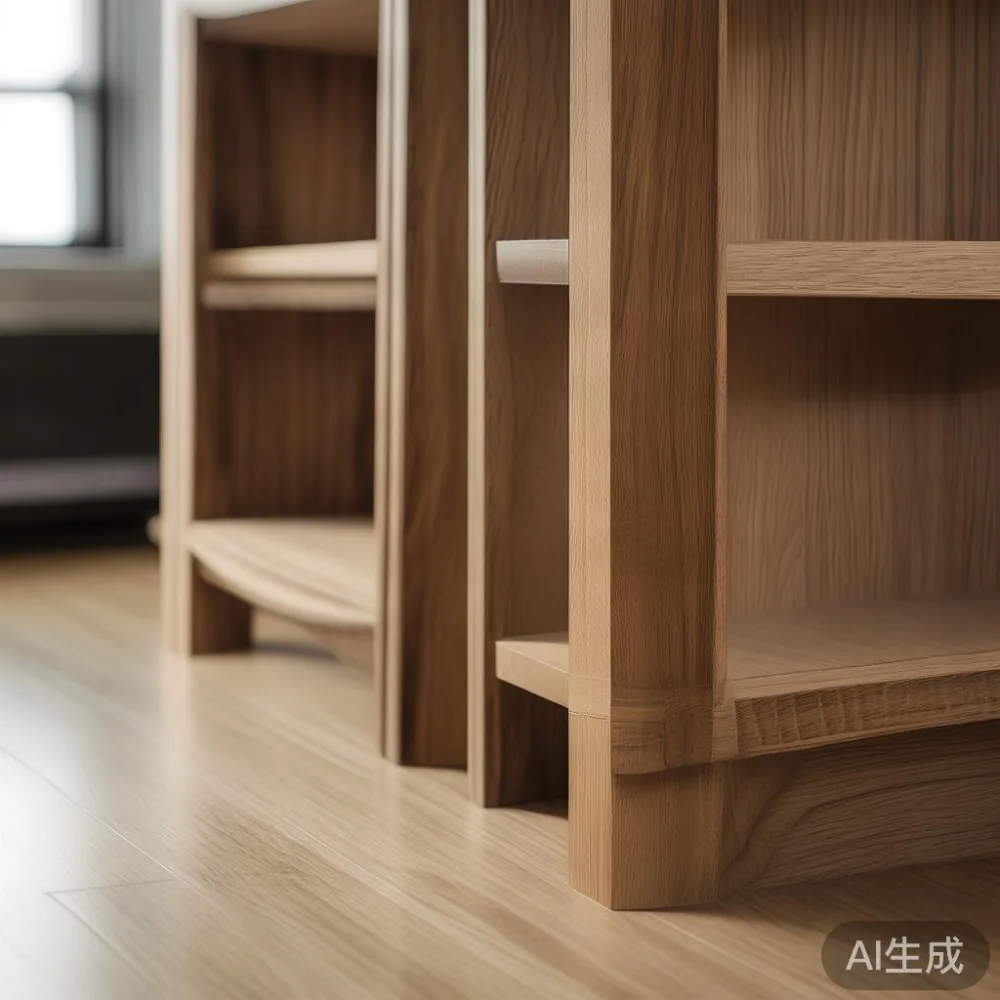
Solid wood behaves differently. A kiln-dried oak shelf at 8–10% moisture will gently expand across the grain by 1.5 to 2.5 mm over a 180 cm span in July, then contract again in February when indoor RH drops under 4H. That is normal. The shelf does not delaminate. A client of mine in a Punggol Waterway terrace reported his 2019 solid ash bookshelf had developed a 1.8 mm gap between two top shelves by the third Chinese New Year, but nothing structural failed. In contrast, his sister's identical-size veneer shelf from a famous local chain showed corner swelling by month 22 and was replaced under warranty — only for the replacement to do the same thing by month 14.
If you want numbers: a S$380 veneer shelf replaced once under warranty (S$2.00 transport, S$0 disposal) and once out of warranty (S$380 new + S$60 transport) over five years costs roughly S$820 in real terms. The S$1,890 solid oak shelf, untouched, costs S$1,890 — but it still functions at year five with refinishing, while the veneer pair is in a landfill.
Is a solid wood bookshelf actually cheaper than veneer over five years?
Run the math carefully and the answer flips. I built a spreadsheet last week for a reader in Bedok Reservoir, comparing two scenarios for a household that reads around 40 books and keeps ceramics on display:
Scenario A — veneer bookshelf, S$480, replaced at year 2.5 due to bubbling:
Item 1: Purchase, S$480 Item 2: 9% GST, S$43.20 Item 3: Delivery, S$70 Item 4: Disposal at year 2.5, S$40 Item 5: Replacement unit, S$480 + GST S$43.20 + delivery S$70 Item 6: Final disposal at year 5, S$40 Total: S$1,266.40 over 60 months.
Scenario B — solid oak bookshelf, S$1,890, with one round of light refinishing at year 3 (S$180):
Item 1: Purchase, S$1,890 Item 2: 9% GST, S$170.10 Item 3: Delivery, S$0 (above the S$350 free-shipping threshold commonly offered) Item 4: Refinishing, S$180 Item 5: Minor hardware (2 cam locks, 4 shelf pins), S$15 Total: S$2,255.10 over 60 months.
The absolute spread narrows to roughly S$990 across five years — about S$16.50 a month. For many households, that is the cost of two cups of kopi at the Tampines Hub hawker centre. In return, you get a unit which retains around 78% of resale value on Carousell, can be moved between HDB and a future condo in Punggol or Marine Parade, and does not dump 28 kg of particleboard into a Semakau landfill cell.
How can a Singapore buyer tell a solid wood bookshelf from veneer in 15 minutes?
There is a tactile test every interior designer I trust uses in the Jurong Lake District showroom circuit. Five checks, in order:
1. Weight. A genuine 180 cm oak bookshelf weighs 32–48 kg. A same-size veneer-MDF unit weighs 18–26 kg. If two people can lift it without effort, the core is not solid hardwood. 2. End grain. Look at the underside of a fixed shelf. On solid wood, you see continuous growth rings running edge to edge. On veneer, you see a uniform pale brown MDF with a thin printed film. 3. Edge band. A 0.4 mm PVC edge band peels off with a fingernail after a year. Solid wood shows the same grain pattern wrapping around the edge. 4. Smell. Freshly cut oak or ash smells faintly of vanilla and tannin. MDF smells of glue and wet paper, especially in a non-air-conditioned corridor. 5. Joinery. Solid shelves use mortise-and-tenon, dovetail, or confirmed dowels. Veneer units rely on cam locks, confirmat screws, and plastic corner brackets.
Ask the seller for the FSC or PEFC chain-of-custody code. Real importers — including Foshan-based workshops shipping through the Shenzhen - Singapore sea route with HS code 9403.60 — will hand over a doc in 24 hours. Anyone who refuses the question is selling veneer.
Which light-luxury design families pair best with a real solid wood bookshelf?
Singapore condos built between 2019 and 2025, particularly in Punggol Northshore and Tampines GreenRidges, lean towards three light-luxury vocabularies. The first is French light luxury, with parquet-style chevron, brushed brass handles, and limestone-tone walls. A solid oak bookshelf with a 1.2 cm chamfered edge slots straight into that mood. The second is American light luxury, drawing on mid-century walnut, blackened steel frames, and caramel leather seating. A 175 cm walnut bookshelf with a 3 cm plinth base and a 2 cm overhang fits the brief.
That is also why searches for the top 10 light luxury furniture pieces keep returning shelving first, then dining tables, then wardrobes. The third vocabulary is post-modern light luxury, mixing travertine, smoked glass, and 1970s curves — a category where a solid ash bookshelf with a 4 cm cantilevered top shelf becomes a sculptural anchor rather than background storage. In the same vein, a solid wood sofa, a bed frame with a 22 cm headboard, a dining table on tapered legs, and a coordinated wardrobe all read more coherently when the bookshelf is real wood rather than printed film.
If you are scouting a single anchor piece, a European light luxury coffee table in Calacatta-look sintered stone over a solid oak base is a reliable pairing for the room. The stone top resists kopi spills, while the wood legs share species with the bookshelf across the wall.
Is a Japanese wardrobe worth it for a Singapore home, and does the same logic apply to bookshelves?
Plenty of buyers ask me this at showrooms. A Japanese wardrobe — typically a 240 cm tall, 120 cm wide, 60 cm deep unit built from solid hinoki, kiri, or paulownia, with full-extension edges and 12 mm drawer slides — is engineered for a region with very different humidity and earthquake cycles. For Singapore, the question becomes: do you want the build quality, and can your HDB lift handle 38 kg of paulownia per panel?
The logic does translate to bookshelves. A solid oak or ash shelf is heavier than a Japanese hinoki one, but it shares the same virtues: full-length edge grain, full-length grain on every face, and a service life measured in decades rather than years. Lift dimensions matter. Standard HDB passenger lifts are 1.1 m wide × 1.5 m deep × 2.1 m tall, with a door opening of 0.9 m. A flat-pack solid wood bookshelf box of 184 cm × 84 cm × 34 cm passes with 2 cm to spare in a straight lift. A larger heritage unit of 200 cm × 90 cm × 40 cm will not fit and needs hoist-up coordination, adding roughly S$220 to delivery.
What should you budget for a solid wood bookshelf that lasts ten years in Tampines or Punggol?
Three honest price tiers for Singapore, including 9% GST and typical corridor delivery:
1. Entry solid wood, kiln-dried ash, oak, or rubberwood with a 5-year structural warranty: S$1,450 to S$2,200 for 180 cm × 80 cm × 30 cm. Suits most HDB living rooms in Tampines GreenRidges and Bedok Reservoir. 2. Mid-tier, North American white oak, kiln-dried to 8%, with a 10-year structural warranty and lifetime refinishing: S$2,400 to S$3,800. This is where the value sweet spot sits for a Punggol BTO or a 1,000 sqm condo in District 15. 3. Heirloom, FSC-certified Burmese teak, kiln-dried to 9%, with dovetailed drawers and brass hardware: S$4,200 to S$6,800. Suits landed property in Bukit Timah or a 10,000 sqft penthouse.
Shipping from China to Singapore runs 18 to 24 days door-to-door for in-stock units, and 35 to 55 days for custom builds. A small Foshan furniture maker with a 14-year export history and a monthly capacity of 800 to 1,500 solid wood bookshelves can typically air-freight a sample batch of 80 units in 11 days for Singapore MRT-area projects.
Do solid wood bookshelves suit French provincial dining rooms in Singapore?
Surprisingly often, yes. A French provincial dining room in a Serangoon Garden or Siglap terrace relies on turned legs, hand-carved aprons, and a creamy limestone-tone palette. A solid oak bookshelf with a 3 cm cornice top, 1.5 cm chamfered edges, and a brushed brass handle pulls the same language into the adjacent study. It is the same reason searches for French provincial for dining room keep returning solid timber as the dominant finish — veneer cannot replicate the depth of grain across a 180 cm vertical surface under Singapore afternoon light. The same applies to dining tables. A French provincial dining table at 200 cm × 95 cm needs a solid wood top at least 3.5 cm thick to resist cupping in our humidity. Anything thinner, even with a clever veneer pattern, will telegraph the MDF substrate by year two. If you are curating the room around a single statement shelf, the top 10 French provincial furniture roundups you find in Singapore design blogs almost always lead with a bookshelf or vitrine, followed by a sideboard, then a marble table accent for the centre of the room. For matching pieces that anchor the rest of the home, a solid wood bed frame with a 25 cm tufted headboard, a dining table on cabriole legs, a 6-door wardrobe in matching grain, and two nightstands reading as a coordinated set will carry the same colour temperature as the shelf. Add a solid wood sofa in oat boucle or sage velvet and the room reads as a single composition rather than a catalogue mix. And if your reading corner extends into 2026, a contemporary best Modern sofa for 2026 in performance boucle — something like a 230 cm wide three-seater on a solid oak plinth — sits comfortably against a heritage oak bookshelf without clashing periods.
What is the honest verdict for a Singapore buyer in 2026?
If your bookshelf is a placeholder for two years while you settle into a new Punggol BTO, a well-built veneer unit at S$480 with a 1-year warranty is a reasonable spend. If your bookshelf is meant to follow you from HDB to a future condo in District 19, or even to a landed house, a solid wood unit from a maker like MIDHILL — a Foshan workshop shipping since 2008 to 15+ countries with a 10-year structural warranty and lifetime refinishing — is the better spend. Over five years, the per-month premium against literal veniture falls to about S$16, the resale of S$1,200 to S$1,500 is roughly S$300 above comparable used units, and you avoid two cycles of landfill disposal.
MIDHILL's showroom samples in Foshan typically sit in a 6,500 sqm workshop with 90 to 110 staff, and a Singapore-bound shipment clears customs in 14 to 18 days. For a household that wants one bookshelf to anchor the next decade rather than the next three years, the math is uncomfortable for veneer and very comfortable for solid wood.