Understand Solid Wood Furniture Pricing in Singapore
I stood in a Tampines HDB corridor last month watching two delivery men try to angle a flat-pack "solid wood" bookshelf through a 90 cm opening. The side panel cracked at the laminate seam, the customer sighed, and the movers asked for another S$80 to haul the broken box back down nine floors. Nobody in that corridor was talking about wood species or kiln-dry schedules. They were talking about a bill. That image is the reason I wanted to write this piece: the price tag on solid wood furniture has very little to do with the sticker on the showroom floor, and almost everything to do with what is — and is not — inside the timber.
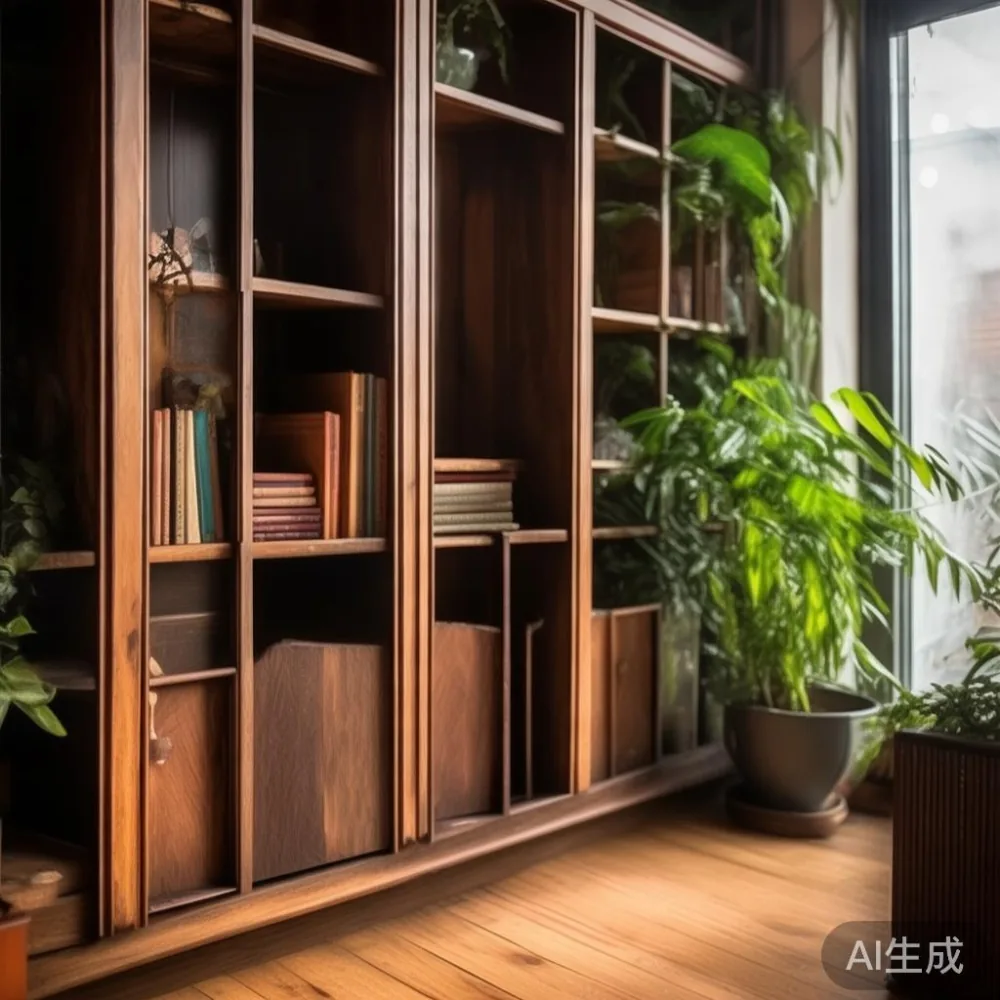
MIDHILL has been cutting, kiln-drying, and assembling solid wood pieces out of Foshan since 2008, shipping to more than 15 countries including Singapore. After looking at enough invoices, spec sheets, and warranty claims, I can tell you that the price of a solid wood bed frame, dining table, sofa, wardrobe, nightstand, or bookshelf breaks down into eight predictable buckets. Some are visible on the product page. Most are not. Below is what I have learned sitting on both sides of the counter.
Why does solid wood cost more than veneer or engineered boards?
It comes down to mass and time. A king-size solid wood bed frame in ash, oak, or walnut typically weighs 60–90 kg. The same silhouette in MDF with a 0.6 mm oak veneer weighs 28–35 kg. Multiply that extra 30–55 kg by the cost of freight from Foshan to a Singapore port, add 9% GST, and you already have a S$120–S$220 gap before anyone has touched the timber. Then add kiln-drying. Genuine kiln-dried ash or oak has to spend 4–8 weeks in a dry kiln to reach the 8–10% moisture content Singapore homes expect; engineered boards skip that step entirely. That time lives inside the price of every solid wood piece you receive.
How much of the price is wood species and grade?
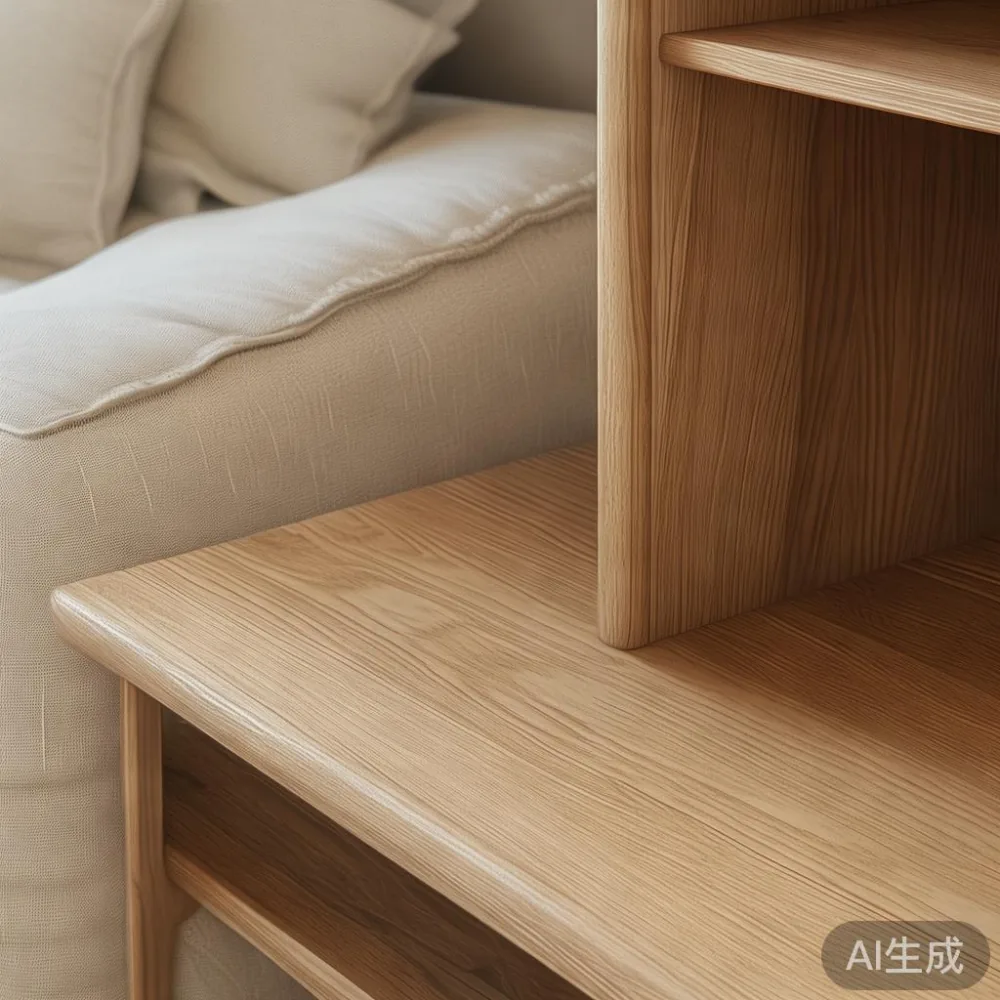
This is the line item most people over-focus on, and the line item suppliers over-quote. Ash and rubberwood sit at the affordable end, white oak and beech in the middle, North American black walnut and Burmese teak at the top. A 1.8 m dining table in rubberwood might land in your Punggol condo at S$1,450–S$1,900, while the same table in solid white oak runs S$2,800–S$3,600, and a walnut version can climb past S$4,800. The reason is not just appearance. Walnut trees take 50–80 years to reach milling size, ash takes 40–60, and rubberwood is a by-product of latex plantations harvested at 25–30 years. Scarcity compounds every year.
Grade matters as much as species. FAS (First and Seconds) timber — the top export grade — allows longer, clearer runs of grain, which means fewer finger joints and fewer visible knots. Lower grades (No. 1 Common, No. 2A Common) are still solid wood, but they will carry small knots, mineral streaks, and shorter sections that must be glued or finger-jointed together. On a 2.0 m bookshelf, the difference between FAS ash and No. 1 Common ash can be roughly S$250–S$400 in the final invoice.
What is the difference between French neoclassical furniture and modern furniture?
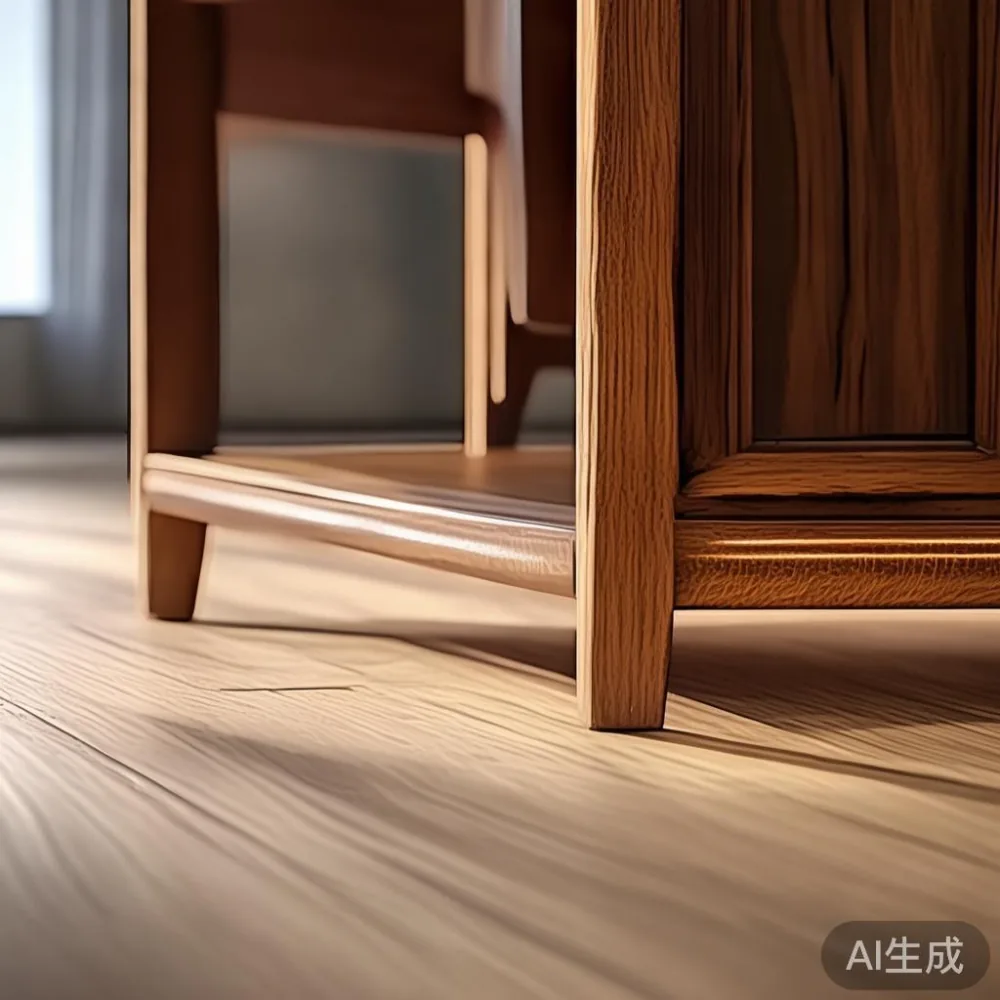
French neoclassical furniture, in the Louis XVI and Directoire tradition running roughly from 1760 to 1815, is built around strict symmetry, fluted tapered legs, and restrained ornament such as beaded mouldings, rosettes, and acanthus leaves; the joinery uses mortise-and-tenon with hand-cut dovetails, the secondary woods are typically solid beech, and the surfaces carry hand-rubbed shellac or French polish. Modern furniture by contrast relies on the visual honesty of the material itself, uses flat planes, exposed joinery, and minimal hardware, and the most fashionable strand right now is a French light luxury / post-modern light luxury vocabulary that pairs pale ash, white oak, and light walnut with brushed brass, micro-cement tops, and matte travertine on accent pieces like a marble table or bedside nightstand. The price gap between the two reflects labour hours and hardware weight far more than wood cost — a neoclassical dining chair can carry 14–18 hours of carving and finishing, while a modern ash wood industrial style dining chair in the same price band carries maybe 3 hours.
How does joinery and hardware change the number on the invoice?
Look at the back of a wardrobe or the inside of a bookshelf drawer. If you see staples, screws driven directly into particleboard, or plastic corner brackets, you are looking at knockdown construction designed for flat-pack efficiency. If you see through-tenons, sliding dovetails, mortise-and-tenon frames, and solid wood drawer boxes with hand-cut dovetail corners, you are looking at the labour that adds S$300–S$900 to a typical wardrobe and roughly S$80–S$150 per drawer to a chest. Hardware follows the same pattern. Soft-close Blum or Hettich runners on every drawer cost S$25–S$55 per pair more than basic epoxy runners; full-extension runners cost more again; and on a six-drawer dresser that line item alone is S$150–S$330.
Upholstery on a solid wood sofa pulls another cost lever. An 8-way hand-tied spring system takes 6–8 hours of a skilled worker's time per sofa; sinuous S-springs take roughly 45 minutes. Down-and-feather cushion fills double the labour of high-resilience foam. That is why a solid wood sofa frame with hand-tied springs and down wraps can land at S$3,800–S$6,500 in Singapore, while a visually identical sofa with sinuous springs and foam sits at S$1,900–S$2,600.
What does shipping into a Singapore HDB or condo actually cost?
This is the bucket almost nobody prices correctly until the truck arrives. Singapore HDB corridors are typically 1.2–1.5 m wide, and lift cabins in most blocks built before 2015 are around 1.1 m deep by 1.4 m wide with a 630–850 kg load limit. A king-size solid wood bed frame in a fully assembled form will not fit. Even a 2.0 m bookshelf usually has to come flat-packed or in two sections. Reputable Foshan suppliers such as MIDHILL quote shipping into Singapore by cubic metre (CBM) — currently about US$90–S$140 per CBM by sea to a Singapore forwarder, plus S$80–S$220 for the last-mile lorry from the forwarder warehouse to your door in Tampines, Bedok, or Punggol, plus 9% GST on the CIF value, plus a lift-booking fee of roughly S$40–S$90 if the building requires a reserved lift slot.
If your unit is on the 20th floor of a new condo with a wider 1.5 m x 1.8 m lift, the per-trip cost drops because one delivery can carry more volume, and the per-piece price improves. If you live in an older walk-up, expect a S$60–S$150 surcharge per floor after the third storey. None of these costs are negotiable, but they are predictable, and a transparent quote from your supplier should list them as separate line items rather than rolling them into the furniture price.
Why are finishes and protective coatings such a hidden cost?
Because the can looks the same on the outside. A two-component conversion varnish (acid-catalysed) costs three to four times as much per litre as a standard nitrocellulose lacquer, and a water-based UV-cured polyurethane finish costs roughly twice as much again when you factor in the curing line. Those finishes are what stop your white oak dining table from blooming with white rings the night someone sets down a sweaty glass of iced lemon tea. They are also what let a supplier offer a 10-year structural warranty without writing a cheque they cannot cash. MIDHILL's 10-year structural warranty, for example, only stays meaningful because the company controls the finishing line in Foshan and the kilns that feed it.
Finishing labour also matters. A hand-rubbed oil finish on a walnut bookshelf — the kind that lets you feel the open grain of the timber — adds roughly 3–5 hours of skilled labour per piece, which on Singapore wages translates to S$90–S$180 per bookshelf. A sprayed matte lacquer on the same piece takes 30–45 minutes. Both look acceptable under showroom lighting. Only one survives a Bedok afternoon thunderstorm with the windows open.
How much should you pay for a warranty that actually pays out?
Read the small print. A "lifetime warranty" that excludes everything except the original receipt is worth nothing. A 10-year structural warranty that names the timber, the joint, and the failure mode — for instance, "solid wood bed frame rails cracking across the grain, not including surface checking" — is worth real money. Lifetime refinishing, by contrast, is a service-cost cap rather than an insurance product: the supplier agrees to strip, sand, and re-finish your bookshelf or dining table once every 5–10 years at a fixed workshop fee (typically S$180–S$420 per piece, plus shipping). Refinishing on locally re-sold pieces routinely costs S$600–S$1,200 per piece in Singapore because the workshop has to source food-safe finishes separately.
Returns are another cost bucket. Singapore's Consumer Protection (Fair Trading) Act gives you strong rights on defective goods, but a 14-day change-of-mind return with free collection still costs the supplier S$120–S$260 in two-way freight on a dining table, which is why most reputable Foshan factories either absorb that cost and build it into the price or pass it through as a 12–18% restocking fee. MIDHILL absorbs two-way freight for change-of-mind returns within 14 days on orders over US$350, which is roughly S$480 — above that threshold, the supplier eats roughly S$240 of risk per return. That risk is real, and it is priced in.
What should you actually budget for a quality solid wood set in 2026?
Here are realistic Singapore-delivered price bands for what a well-made Foshan factory ships today, including 9% GST, last-mile delivery to an HDB, and lift booking. A solid wood dining table for six in ash or rubberwood: S$1,450–S$2,200. In white oak: S$2,800–S$3,600. A queen-size solid wood bed frame in ash: S$1,100–S$1,900. In walnut: S$2,400–S$3,800. A 2.0 m bookshelf with adjustable shelves in ash: S$1,250–S$2,100. A four-door solid wood wardrobe: S$3,200–S$6,400 depending on internal configuration. A solid wood sofa frame with hand-tied springs and performance fabric: S$3,800–S$6,500. A bedside nightstand pair in ash or oak: S$780–S$1,400. A small marble table accent piece with an ash or oak base: S$950–S$2,200.
Set your budget on the median of those ranges, not the floor. The floor usually means thinner solid panels (16–18 mm instead of 22–25 mm), paper-backed veneer on secondary surfaces inside wardrobes, and sinuous springs on sofa frames. None of those choices are dishonest, but none of them will still be holding a 35 kg stack of coffee-table books in 2036 either. If you are furnishing a 4-room HDB in Punggol with a dining table, six chairs, a sofa, a queen bed, two nightstands, a 2.0 m bookshelf, and a four-door wardrobe, the realistic all-in Singapore figure sits between S$14,000 and S$24,000 for honest solid wood from a factory with a real kiln and a real warranty.
A practical checklist before you pay the deposit
Ask for the timber's common name and its Latin name (ash = Fraxinus spp., white oak = Quercus alba, rubberwood = Hevea brasiliensis). Ask for the moisture content on the spec sheet — anything above 12% is a red flag for Singapore. Ask whether the back panel of the wardrobe and the back of the bookshelf are solid wood, plywood, or MDF; the answer determines whether the piece will rack over time. Ask for a sample of the finish on a 10 cm x 10 cm offcut, then pour a cold glass of water on it for 15 minutes. Ask for the warranty in writing with the failure modes listed. Ask who handles Singapore-side delivery, and whether the quote includes the lift booking. Ask whether the price includes 9% GST as a separate line item. A factory that answers those eight questions in writing before you pay is a factory that will still be answering your emails in 2031. A factory that refuses any one of them is the supplier whose delivery men will be standing in a Tampines corridor next month, looking at a cracked bookshelf, asking for another S$80.