Bookshelf Singapore: What I Wish I Knew Before Buying One for My HDB
What bookshelf size actually fits a 3-room HDB without crowding the room?
Mapping the wall before measuring
Standard bookshelf heights in Singapore
Bookshelf depths that swallow paperbacks and art books
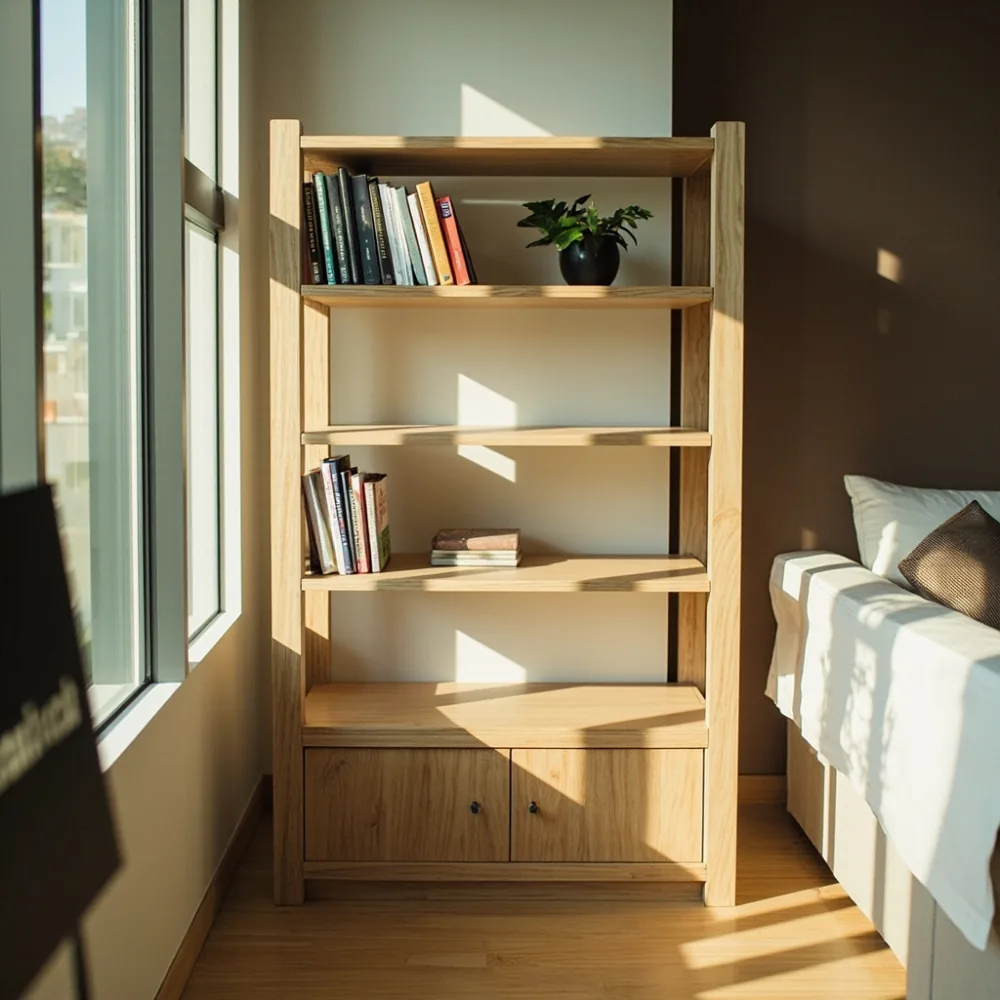
I learned the hard way that a bookshelf in a Singapore HDB has to work harder than the same piece in a landed property. In a typical 3-room flat of about 65 sqm, the living room wall is usually 2.4 to 3.2 m wide once you account for the air-con ledge and the door swing. A 120 cm wide, 180 cm tall unit is the sweet spot: wide enough to anchor a wall, narrow enough to leave 600 cm of clear floor on each side so the room still breathes.
My current unit is 150 cm wide x 200 cm tall x 32 cm deep. That extra 30 cm of height matters because Singapore ceiling heights in newer BTOs hover around 2.6 m, so going taller means a ladder and a weekly argument with myself. For a 4-room HDB around 90 sqm, I would push to 180 cm wide without hesitation. In a condo, ceiling heights often hit 2.8 to 3 m, so taller shelving becomes a real option, but the room footprint is usually smaller, so go vertical instead of wide.
Depth is the dimension people forget. Anything under 25 cm looks elegant but will not hold hardcover art books, which run 26 to 30 cm tall when stacked. I treat 30 cm as the minimum and 35 cm as the comfortable zone. If you collect vinyl or playstation boxes, you are now in custom territory.
Does humidity really ruin a solid wood bookshelf in Singapore?
Why MDF swells and solid wood breathes
Acclimatising new furniture for 7-14 days
Finishes that survive a non-aircon room
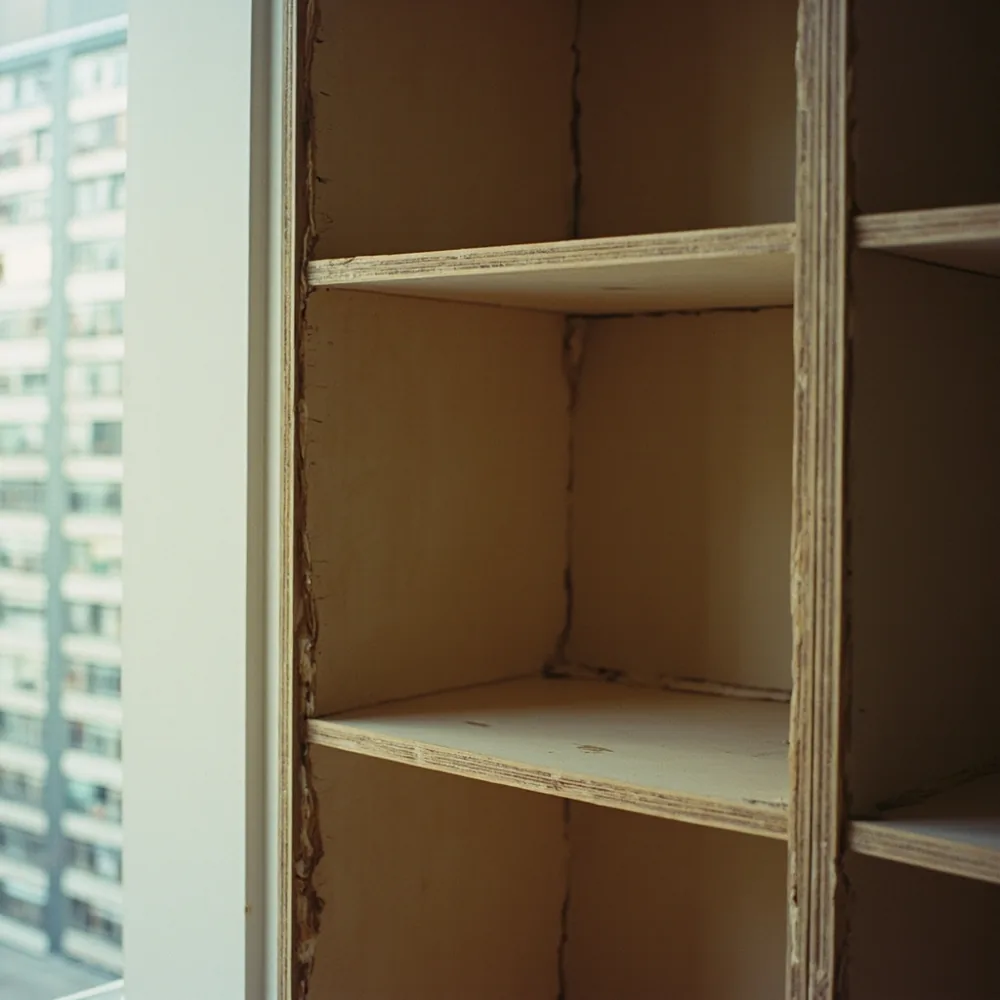
Yes, humidity ruins poorly made ones. Engineered boards like MDF and particleboard absorb moisture along their cut edges, swell, and never recover. I have seen a $400 particleboard shelf bow outward by 8 mm within six months in a Pasir Ris HDB that the owner aired out daily. Solid wood furniture, by contrast, expands across the grain, not along it, so a 200 cm tall teak post might grow 2 to 3 mm in a wet week and shrink back in February.
That said, "solid wood" on a price tag does not mean "indestructible." I treat any bookshelf under SGD 600 for a 150 cm unit as suspect unless the seller publishes the wood species and the joinery. Cheap rubberwood from China labelled as "oak" is the most common trick. Mid-range makers use ash, beech, or rubberwood properly kiln-dried to 8-10 percent moisture content. Foshan-based makers like MIDHILL, established in 2008, kiln-dry their solid wood furniture and back it with a 10-year structural warranty, which is the kind of paper trail I want when the aircon breaks.
For daily care, keep the shelf 10 cm off any exterior wall to let air move behind it. If your room is aircon-only, run the unit on dry mode two hours a day during the wet season. A basic hygrometer costs 12 SGD and saves furniture.
Which bookshelf materials survive Singapore's weather for 10+ years?
Solid hardwoods ranked by stability
Engineered options worth considering
Metal and glass hybrids
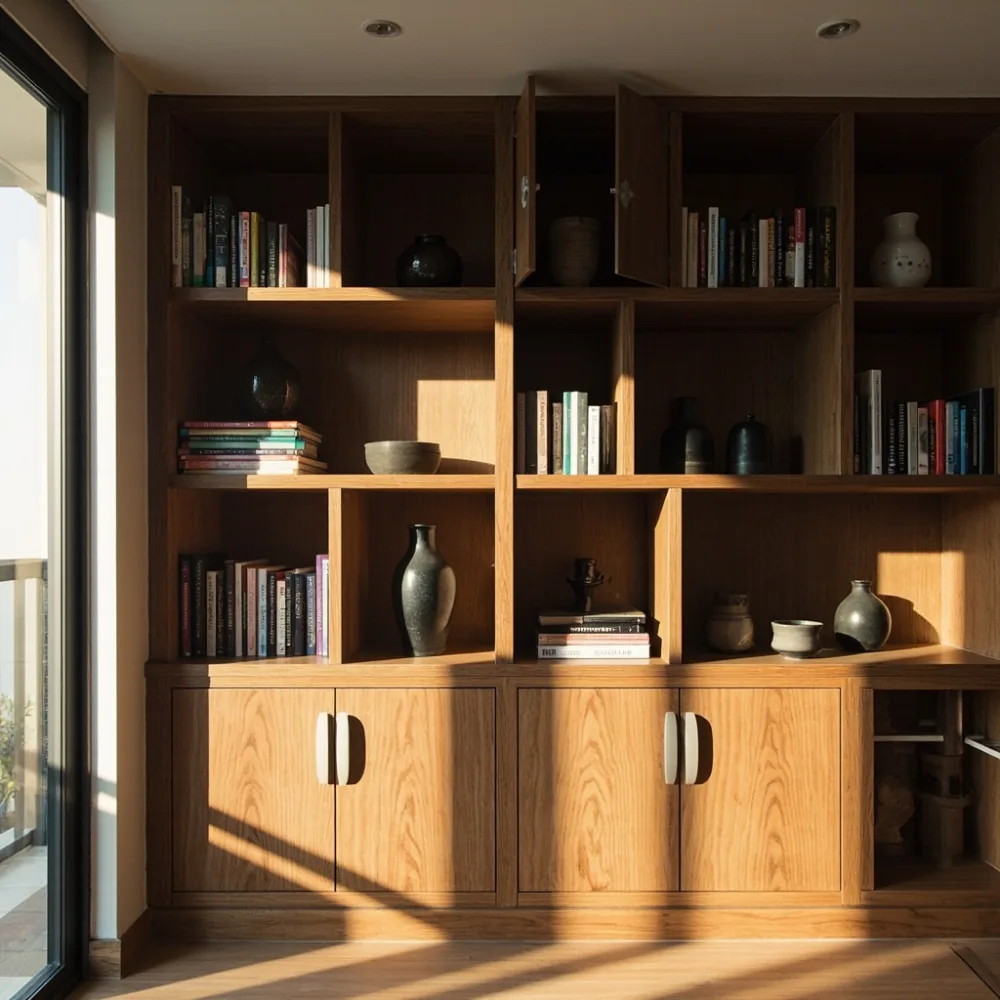
After watching three shelves fail in different flats, I rank materials by what I have actually seen survive.
| Material | Typical lifespan in SG | Humidity response | Price band (150 cm unit, SGD) |
|---|---|---|---|
| Teak solid wood | 15-25 years | Very stable, natural oils resist moisture | 1,400-2,800 |
| Ash solid wood | 12-18 years | Stable, slight seasonal movement | 900-1,600 |
| Rubberwood (kiln-dried) | 8-12 years | Stable if sealed on all sides | 500-900 |
| MDF with melamine | 4-7 years | Edges swell if cut or chipped | 250-500 |
| Plywood with veneer | 7-10 years | Better than MDF, still layers risk | 400-800 |
| Powder-coated steel frame with shelves | 15+ years | Immune to humidity, can rust at welds | 600-1,200 |
If you want a bookshelf to outlive your lease, pay for solid hardwood or steel. Plywood with a real wood veneer is the honest mid-point. Anything labelled "MDF" is fine for a study nook but not a main living room piece.
How much should a good bookshelf cost in Singapore in 2026?
What drives the price up
Where the money actually goes
Reading the warranty fine print
In Singapore, a 150 cm tall x 80 cm wide x 30 cm deep bookshelf in 2026 prices roughly like this:
- MDF flat-pack from a large retailer: 200-400 SGD. Self-assembly, 3-5 year realistic life.
- Plywood with veneer from a local custom shop in Tai Seng or Defu: 600-1,000 SGD. Includes delivery and basic installation.
- Solid ash or beech from a regional maker: 900-1,600 SGD. Delivery 2-4 weeks, often with anti-tip wall anchor included.
- Solid teak from a custom furniture workshop: 1,800-3,500 SGD. 6-10 week lead time, fully custom sizes.
- Designer European brand (Boconcept, BoConcept, Montana equivalent): 2,500-5,500 SGD. Showroom pieces, 8-12 week delivery, no real customisation.
The price gap between MDF and solid ash is mostly labour and drying time, not markup. Kiln-drying wood to 8 percent moisture takes 4 to 12 weeks depending on thickness. Custom furniture shops charge for that cycle. Flat-pack retailers do not dry anything because they use engineered board.
I treat any quote above 4,000 SGD for a single bookshelf as either designer branding or fully bespoke joinery, and I want to see shop drawings before paying a deposit above 30 percent.
Can a bookshelf get through my HDB door and lift?
The 90 cm door problem
Lift sizes in newer BTOs
Disassembling and re-assembling
This is the question I wish more buyers asked before paying a deposit. Older HDB doors from the 1980s and 1990s measure 80 to 85 cm wide. Newer BTO doors are wider, around 90 to 95 cm. The lift in most blocks has a clear opening of about 80 cm wide by 210 cm tall, with the cabin roughly 150 cm wide by 180 cm deep.
A bookshelf wider than 80 cm in any single piece simply will not fit through the door at right angles. My workaround has been:
- Order shelves that ship in two halves with a centre post, each half under 75 cm wide.
- Choose flat-pack designs that assemble inside the room. A 180 cm unit breaks down into 4-6 panels under 30 cm wide each.
- For landed property in districts 10, 13, and 21, full-size delivery is usually fine since the front gate is wider and there is no lift.
Always ask the seller for the box dimensions, not just the assembled dimensions. A 150 cm shelf that ships in one 155 x 35 x 20 cm box will not clear a tight stairwell corner in a walk-up. Custom furniture makers like MIDHILL design their packaging around Singapore access, with most bookshelves split into two side panels under 80 cm wide and three or four shelves that stack flat. That single detail has saved me one aborted delivery and a SGD 80 re-delivery fee.
Open shelving or closed cabinets: what works better in a small space?
Dust on books in Singapore
Visual weight in a 65 sqm flat
Mixed-media audit
Open shelving shows everything, and in Singapore that means a fine layer of humid-day dust plus the occasional gecko trail. I prefer open shelves for items I actually read weekly, and closed cabinets below for hardware, board games, and the cables I keep meaning to organise.
In a 3-room HDB, I now default to a 2/3 open, 1/3 closed configuration: top two-thirds open shelves at 30 cm deep, bottom third as a 35 cm deep cabinet with two doors. That gives roughly 18-22 linear metres of shelf space, enough for 80 to 120 hardcovers depending on size. Closed cabinets (type 2) hide the visual weight so the room reads as lighter. For a small space furniture strategy, this is the single best trick I know.
If you collect vinyl, books, and want to display a few objects, the standard half-and-half 50-50 split often dominates the room. I would rather lose 30 percent of shelf space and gain the room feeling.
How do I anchor a bookshelf so it does not tip on a child or a dog?
The 30-second tip test
Wall types in HDB vs condo
Anchors that actually hold
Any bookshelf over 120 cm tall should be anchored. The 30-second test: load the top shelf with the heaviest books you own, then push the unit at the top with one hand. If the base lifts at all, you need an anchor.
HDB walls are typically 100 to 150 mm hollow concrete with a skim coat. Condo walls vary wildly: some are drywall on metal studs, some are solid concrete. For hollow concrete, use a 6 mm or 8 mm expansion anchor with a steel L-bracket. For drywall (common in newer condos), use a toggle bolt that opens behind the board. Plastic anchors are decorative, not structural.
I run one bracket at the top rear, one at the middle if the unit is over 180 cm tall. Cost is under 10 SGD per bracket at any Tampines or Bukit Merah hardware shop. The wall anchor costs less than the hospital visit.
Should I buy a bookshelf locally or ship from China?
Lead times and what they mean
Warranty reality
Delivery cost truth
For ready-made pieces, local Singapore stockists deliver in 3-7 days. China direct delivers in 4-8 weeks by sea, sometimes faster by air at 3-4x the cost. For custom sizes, both local and Foshan makers take 4-8 weeks. The lead time tells you what is happening: short lead times mean the piece is already made in someone else's warehouse, not made for you.
Warranty is the deciding factor for me. A local shop with a 2-year warranty and a real address beats an overseas factory that disappears the moment you email. Foshan makers with 10-year structural warranties, like MIDHILL, sit in a useful middle: factory direct pricing with a real warranty paper you can enforce. I keep a PDF of the warranty and the invoice in a folder labelled "furniture," which has paid off twice.
Delivery cost from China direct runs 120-300 SGD for a single shelf via sea freight, plus 7 percent GST on the declared value above 100 SGD. Local delivery is typically 60-120 SGD including assembly. For a single shelf, local usually wins on total price once you add time, risk, and the GST.
What bookshelf styles actually age well in Singapore homes?
Scandi-minimalist
Mid-century modern
Linden HDB classic
Trends age fast. A bright orange bookshelf from 2018 now looks like a 2018 label on your living room. Styles I have seen survive 10+ years in Singapore flats:
- Scandi-minimalist in light oak or ash, with 30 cm deep shelves and visible wood grain. Reads as calm, matches any leather sofa or fabric sofa you pair it with.
- Mid-century modern with slim tapered legs in walnut or teak. The legs are the weakest point in our humid climate, so check they are not particleboard with veneer.
- The "HDB classic" two-column with adjustable shelves and a closed cabinet below. Functional, unremarkable, never out of place.
Whatever you choose, avoid high-gloss lacquer in a non-aircon room. The finish clouds within two wet seasons. Matte hardwax oil or a low-sheen polyurethane wears better and can be re-oiled at home with a 30 SGD tin.
Frequently asked questions
What is the best bookshelf height for a Singapore HDB?
For a standard 2.6 m ceiling in a 3-room or 4-room HDB, I recommend 180 to 200 cm tall. Anything taller requires a step stool and becomes a safety issue around children. Go wider before going taller: an 80 cm wide x 200 cm unit beats a 50 cm x 240 cm tower in daily use.
How long does delivery take from a Foshan furniture maker to Singapore?
Sea freight from Foshan to Singapore takes 7 to 14 days door-to-door once the piece is finished. Custom production adds 4 to 8 weeks before shipping. Total lead time from order to your living room is typically 6 to 10 weeks for solid wood custom furniture, and 2 to 4 weeks for stocked designs.
Do I need to worry about bookshelf humidity in an aircon room?
Aircon removes a lot of moisture, but it cycles off, and Singapore ambient humidity seeps back in within hours. A hygrometer is worth the 12 SGD. Keep relative humidity between 45 and 60 percent, leave 10 cm behind the shelf, and avoid placing it directly under or beside a window.
Can I customise a bookshelf to fit an odd HDB wall?
Yes. Most local custom shops and regional makers like MIDHILL will adjust width in 5 cm steps at no extra cost, and depth in 2 cm steps. Height customisation is usually free up to 240 cm. Custom finishes, like adding cable cutouts for a media setup, typically add 80-150 SGD and 1-2 weeks.
Questions about specifications, fabric or delivery? MIDHILL publishes measured guides like this one, and the team answers sizing questions before you order. See the full collection or contact the team.